


India’s Ascent: On Track to Join the Upper-Middle-Income League by 2030
- InduQin
- Jan 21
- 4 min read
Updated: Jan 23

India is projected to enter the World Bank’s upper-middle-income category by 2030, with per capita GNI nearing $4,000.
Economic expansion has accelerated, with GDP expected to reach $5 trillion soon.
Per capita income has doubled rapidly since 2009.
India’s global growth ranking has strengthened significantly.
Sustained momentum supports long-term high-income aspirations.
India is poised to reach a significant economic milestone by the end of this decade, with projections indicating it will enter the World Bank’s upper-middle-income category. An analysis by the State Bank of India (SBI) suggests that the country’s gross national income (GNI) per capita is likely to touch around $4,000 by 2030, a level that would place India alongside nations such as China and Indonesia under the World Bank’s current income classification framework.
Data from the World Bank, which categorizes economies based on per capita GNI in US dollar terms, highlights a steady global shift over the past three decades. Between 1990 and 2024, the number of high-income and upper-middle-income economies expanded considerably, while the count of low-income countries declined. China exemplifies this transformation: once a low-income economy with a per capita GNI of just $330 in 1990, it had advanced into the upper-middle-income group by 2024. Indonesia’s trajectory has been similar, also progressing from low income to upper-middle income over the same period.
How Global Income Groups Have Changed
The World Bank divides economies into four broad income categories: low income, lower-middle income, upper-middle income, and high income. In 1990, when 218 economies were assessed, low-income countries numbered 51, lower-middle-income economies stood at 56, upper-middle-income countries at 29, and high-income economies at 39. By 2024, this landscape had shifted sharply. Low-income economies fell to 26, lower-middle-income countries to 50, while the upper-middle-income group grew to 54. The most dramatic change was seen among high-income economies, which more than doubled to 87.
India’s Long but Steady Transition
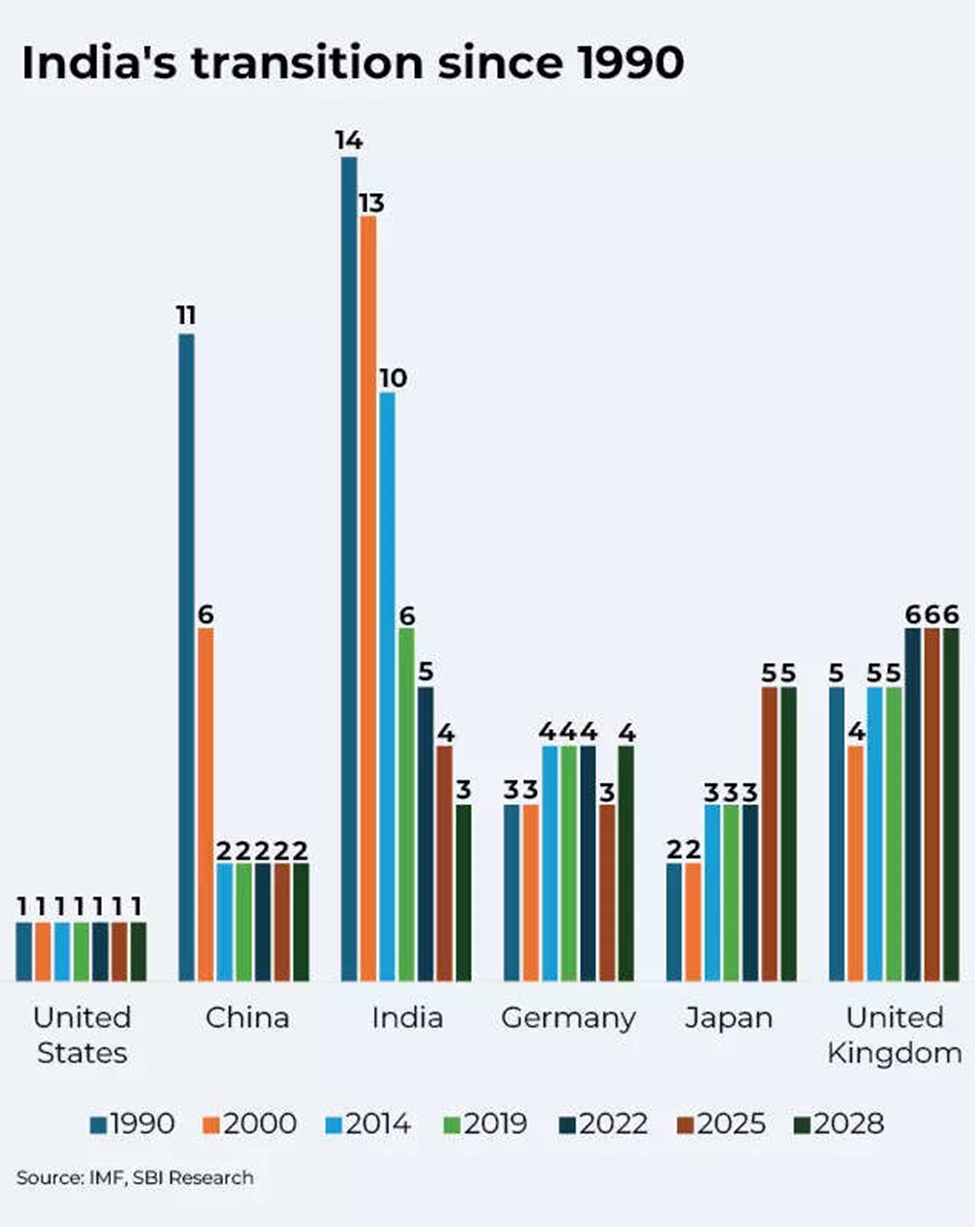
Among the world’s major economies, the United States continues to rank as the largest, followed by China. India, however, is steadily closing the gap and is projected to surpass Germany to become the third-largest economy globally by 2028.
India’s rise in per capita income has been comparatively gradual. According to SBI, it took nearly 60 years for the country to move from low-income status to the lower-middle-income bracket, a transition that was completed in 2007. During this period, per capita GNI increased from about $90 in 1962 to $910, translating into an average annual growth rate of roughly 5.3 percent.
From Trillion-Dollar Economy to Upper-Middle Income
India’s overall economic expansion has accelerated in recent decades. After taking six decades to reach a $1 trillion GDP milestone, the economy doubled to $2 trillion within the next seven years, hitting that mark by 2014. Another trillion was added by 2021, with GDP crossing $4 trillion by 2025. Current projections indicate that the $5 trillion mark could be achieved within the next two years.
On a per capita basis, income crossed $1,000 in 2009 and doubled to $2,000 by 2019. It is expected to reach approximately $3,000 by 2026. SBI’s projections indicate that per capita GNI could climb to around $4,000 by 2030, clearing the threshold required for India to be classified as an upper-middle-income economy.
The SBI report also points to a notable improvement in India’s growth performance relative to other countries. Over the past decade, India’s position in the global distribution of average real GDP growth has strengthened, with its percentile ranking rising from the 92nd percentile (measured over a 25-year period) to the 95th percentile. This shift underscores India’s growing presence among the world’s faster-growing economies.
Looking Beyond: The High-Income Aspiration
SBI has also examined what it would take for India to eventually enter the high-income category. If the current high-income threshold of $13,936 per capita GNI were to be reached by 2047, in line with the “Viksit Bharat” vision, India would need to sustain per capita GNI growth of about 7.5 percent annually. This appears feasible, given that per capita GNI grew at an average rate of 8.3 percent between 2001 and 2024.
However, the report cautions that the high-income benchmark itself is likely to rise over time. If the threshold increases to around $18,000, India would need to maintain even faster growth—close to 8.9 percent annually over the next 23 years—to achieve high-income status by 2047.
Even so, SBI remains confident about the nearer-term goal. Reaching the upper-middle-income category, which currently requires a per capita GNI of roughly $4,500, would call for nominal GDP growth of about 11.5 percent in dollar terms. This pace, the report notes, is well within reach, given that India recorded nominal dollar GDP growth of around 11 percent in the pre-pandemic period between FY2004 and FY2020, and close to 10 percent between FY2004 and FY2025.
Taken together, the analysis suggests that while the journey has been long, India’s economic momentum places it firmly on course to join the ranks of upper-middle-income countries by the end of the decade, marking a defining chapter in its development story.
Graphics courtesy, Times of India


Comments