


Vande Mataram in Arabic: Suchetha Satish Takes India's 150-year-old national song Beyond Borders
- InduQin
- 1 day ago
- 4 min read
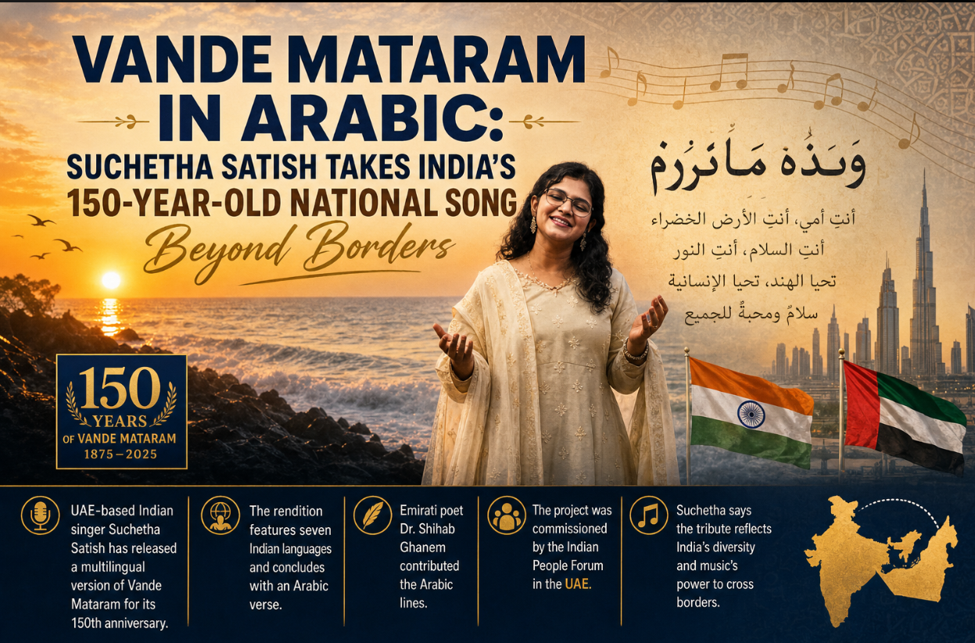
UAE-based Indian singer Suchetha Satish has released a multilingual version of Vande Mataram for its 150th anniversary.
The rendition features seven Indian languages and concludes with an Arabic verse.
Emirati poet Dr. Shihab Ghanem contributed the Arabic lines.
The project was commissioned by the Indian People Forum in the UAE.
Suchetha says the tribute reflects India’s diversity and music’s power to cross borders.
As India observes 150 years of Vande Mataram, UAE-based Indian expatriate singer Suchetha Satish has presented a new interpretation of the national song, giving it a multilingual and international character. Her rendition, titled “Vande Mataram Beyond Borders,” moves through seven Indian languages before ending with a verse in Arabic, symbolically linking India with the UAE, where she is based.
Suchetha, who holds a Guinness World Record for singing in the most languages during a concert, said the idea emerged after the Indian People Forum, a UAE-based organisation of Indian expatriates, invited her to create a special version of the song for its 150th anniversary.
The release came ahead of a renewed political debate in India over parts of the song and the religious imagery in its later verses. At the same time, the Indian government has begun a year-long commemoration of the song’s anniversary. The full version of Vande Mataram was also sung during official flag-hoisting ceremonies for India’s 80th Independence Day, including events held at Indian missions in the UAE on August 15.
For Suchetha, a Dubai-based university student from Kerala, the project was less about controversy and more about honouring a patriotic composition through India’s linguistic richness. She said she wanted the rendition to reflect the country’s many languages while also showing that music is not confined by national boundaries.
That idea, she explained, led her to include Arabic in the tribute. She described Arabic as the language of her “second home” and said its inclusion gave the song a wider cultural resonance.
The Arabic verse was written by veteran Emirati poet Dr. Shihab Ghanem, whose contribution helped shape the final identity of the project. Suchetha said that once Dr. Ghanem’s lines were added, the concept of going “beyond borders” became more meaningful and complete.
Her creative association with Dr. Ghanem is not new. Their collaboration dates back to 2019, when Suchetha worked with composer Monty Sharma on “Fifty Glorious Years,” an Arabic tribute to Sheikh Mohammed bin Rashid Al Maktoum, Vice President and Prime Minister of the UAE and Ruler of Dubai.
During the Covid-19 period, Dr. Ghanem translated one of Suchetha’s awareness songs into Arabic. In 2022, he also translated three Rabindranath Tagore compositions into Arabic for her “Tagore Beyond Horizon” project, in which Suchetha performed the Arabic vocals. Their partnership has since continued through several India-UAE musical initiatives, including projects linked to UAE National Day.
Speaking about the process of adapting Vande Mataram, Suchetha said the challenge was not simply translating words into different languages. The task, she noted, was to preserve the meaning, emotional strength and patriotic spirit of Bankim Chandra Chatterjee’s original composition while ensuring that each language fitted naturally into the melody.
Bankim Chandra Chatterjee, the 19th-century Bengali novelist and a major figure in modern Indian literature, wrote Vande Mataram in 1875. He later included it in his novel “Anandamath,” after which the song became one of the most powerful cultural symbols of India’s freedom movement.
Although Suchetha could have used artificial intelligence for the multilingual adaptation, she chose instead to work with lyricists for the different language sections. The original Bengali and Sanskrit verses by Bankim Chandra Chatterjee were retained.
Devinder Kaur and Simran Sabharwal wrote the Punjabi lines, while Vilas Bakshi worked on the Gujarati portion. Kriss Venugopal contributed the Tamil lyrics, and Amrit Dey handled the Assamese section. Suchetha’s mother, Sumitha Ayilliath, coordinated the production and also wrote the Malayalam lyrics.
The visuals for the project were filmed in Kochi, Kerala, by Kavya Film Company. Music, mixing and mastering were handled in the UAE by Nelson Peter.
The song was officially released in Burhanpur, Madhya Pradesh, by Anand Prakash Chouksey, founder and chairman of Macro Vision Academy. Following the release, Suchetha performed at an Independence Day concert at the academy, attended by about 3,300 people, largely students. She said the experience of seeing such a large gathering connect with the song was deeply memorable.
Known internationally for her ability to sing in more than 155 languages, Suchetha has built much of her musical identity around bridging cultures through song. Her latest tribute continues that approach, bringing together Indian languages, Arabic poetry and a historic patriotic composition.
The release of “Vande Mataram Beyond Borders” comes during a particularly active phase in her career. She recently released “Mitsey,” a Bhutanese-language song that she described as a reflection on life’s joys and hardships and the need to accept both.
She has also lent her voice to the Bollywood track “Hayati,” produced under the DOS Music banner with Sikandar Maan. The song has already crossed 25 million views in about a month.
Suchetha also travelled to Ladakh, where she performed at the “Voices Against Drugs” charity concert on August 20. The event used music as a platform to create awareness among young people about the dangers of drug abuse.
For Suchetha, these varied projects share a common purpose. Whether revisiting a 150-year-old patriotic song or performing at a social awareness concert, she said her goal remains to use music to communicate messages that matter.


Comments