


Indian Surgeon in Wuhan Performs Precision Robotic Procedure on Hyderabad Patient
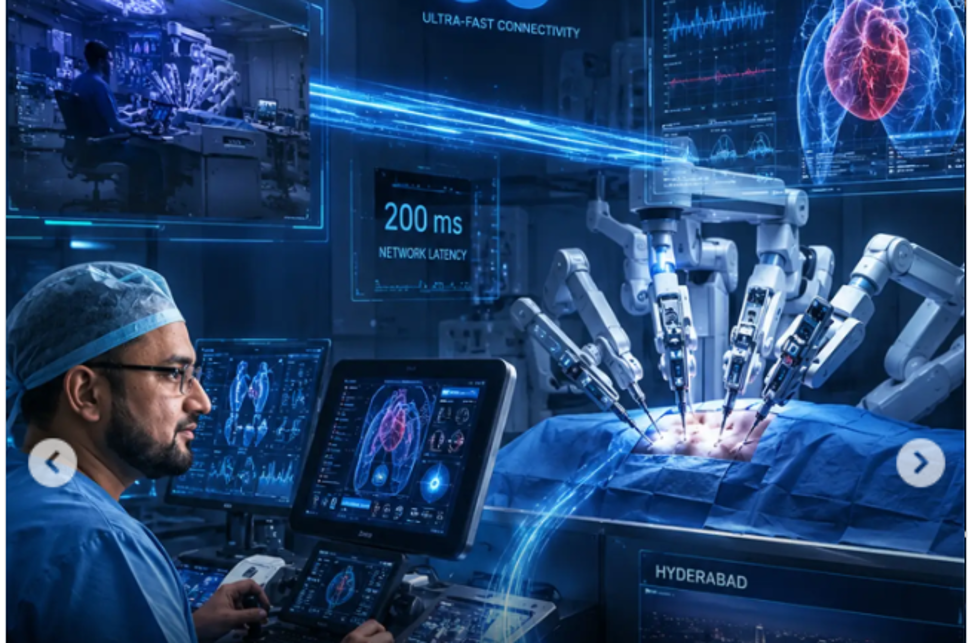
First-of-its-kind cross-border robotic bladder surgery performed from Wuhan on a patient in Hyderabad.
Powered by China-developed robotics and ultra-fast 5G connectivity.
Operation completed in 90 minutes with under 200-millisecond signal delay.
Seamless coordination between medical teams in India and China.
Demonstrates growing role of AI, robotics, and telemedicine in global healthcare access.
Signals future of borderless, technology-driven surgical care.
In a groundbreaking demonstration of how technology is reshaping modern medicine, Indian urologist Dr. Syed Mohammed Ghouse has successfully carried out a complex robot-assisted bladder reconnection surgery on a patient in Hyderabad—while physically stationed nearly 3,000 kilometres away in Wuhan, China.
The procedure, reported by China Daily, marks a significant advancement in international telemedicine and cross-border healthcare collaboration. Using Chinese-developed robotic surgical systems integrated with high-speed 5G connectivity, the operation was completed in approximately 90 minutes. The effort was the result of close coordination between medical teams at Tongji Hospital in Wuhan and specialists on the ground in Hyderabad.
The milestone also drew attention on social media. Yu Jing, spokesperson for the Chinese Embassy in India, highlighted the achievement on X, noting that Dr. Ghouse conducted a robot-assisted ureteral reimplantation on a patient thousands of kilometres away, enabled by advanced robotics and next-generation telecommunications. She described the feat as an example of life-saving treatment that transcends geographical boundaries.
Planning Across Borders
Prior to the surgery, doctors in both cities collaborated virtually to review the patient’s medical history and design a detailed surgical plan. Together, they mapped out the exact trajectory and movements required for the robotic instruments.
While Dr. Ghouse remained at a surgical console in Wuhan, the Hyderabad-based team prepared the patient for the procedure. This included administering anaesthesia and positioning the robotic apparatus in the operating theatre to ensure everything was ready for remote operation.
The robotic system was equipped with highly sensitive surgical tools and advanced 3D imaging cameras. These cameras transmitted real-time, high-definition visuals directly to Dr. Ghouse, enabling him to monitor the surgical field with clarity and precision from afar.
Near-Instantaneous Response Through 5G
Throughout the operation, the robotic arms replicated the surgeon’s hand movements with remarkable accuracy. Thanks to ultra-fast 5G connectivity, commands were transmitted in under 200 milliseconds, allowing for seamless coordination and minimizing delay.
Although the surgery was conducted remotely, doctors in Hyderabad remained by the patient’s side at all times. They were prepared to step in immediately should any complications arise, ensuring patient safety remained paramount.
A Showcase of Surgical Innovation
This procedure was one of 26 surgeries demonstrated during the 10th Congress of the Chinese Chapter of the International Hepato-Pancreato-Biliary Association. Notably, five of these operations featured live international remote collaborations, involving medical professionals from countries such as India, Brazil, Georgia, Greece, and Uzbekistan.
Chen Xiaoping, Director of Surgery at Tongji Hospital and one of the programme’s key architects, emphasized that rapid advancements in artificial intelligence, robotics, and next-generation communication networks are revolutionizing healthcare delivery worldwide. According to Chen, such innovations are paving the way for more accessible, precise, and globally connected medical care.
A Glimpse Into the Future of Medicine
The successful cross-continental surgery underscores how technological integration is dissolving traditional barriers in healthcare. With robotics, AI, and high-speed networks working in tandem, expert surgical care is no longer confined by physical distance.
As international collaborations like this continue to expand, the implications for patients in remote or underserved regions could be transformative—offering access to specialized expertise that was once limited by geography.



Comments