


India’s National Archives Cross Major Milestone with Over 222 Million Pages Digitised
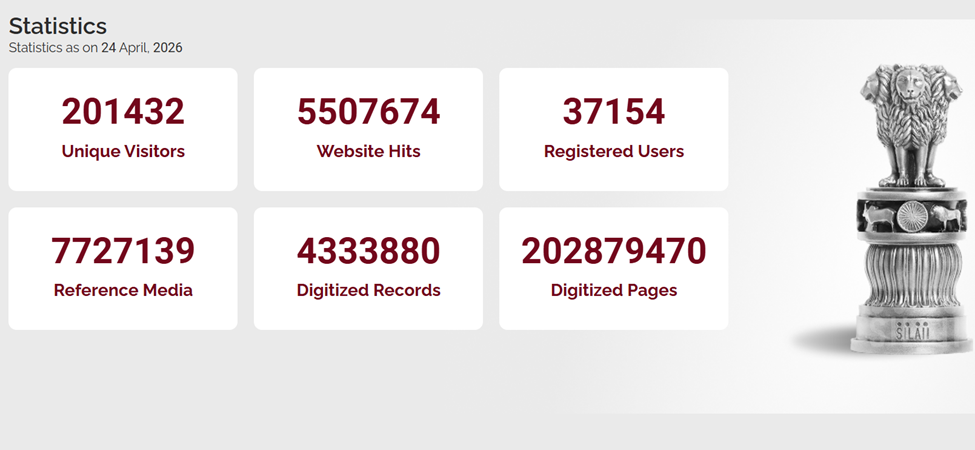
Nearly 60% of National Archives’ 340 million pages digitised; over 200 million pages available online.
Abhilekh Patal portal expands public and researcher access to historical records.
Second phase (launched 2024) targets 300 million pages within two years.
Digitisation pace sharply increased after 2021 leadership changes.
75 scanners deployed nationwide; youth trained under Skill India Mission.
Protects 45 million fragile pages from deterioration.
India’s effort to safeguard its documentary legacy has reached a significant benchmark, with nearly 60 percent of the National Archives of India’s (NAI) vast collection now digitised. Union Culture Minister Gajendra Singh Shekhawat described the achievement as a defining moment in the preservation of the nation’s historical records.
Out of an estimated 340 million pages housed by the NAI, more than 200 million pages have been converted into digital format. These materials have been made accessible through the Abhilekh Patal portal, an online platform designed to provide researchers and citizens with direct access to reference materials and digitised collections. As of April 20, approximately 201.5 million pages—over half of the archive’s total holdings—had been uploaded to the portal.
Highlighting the development on social media, Shekhawat credited the initiative to the government’s broader push to integrate heritage preservation with digital transformation. He noted that more than 200 million pages are now available to the public through the Abhilekh Patal platform, calling it a major step toward transparency and wider access. According to the minister, the initiative not only democratizes historical records but also ensures their protection for generations to come.
Accelerated Digitisation Drive
The latest progress is part of an intensified second phase of digitisation launched in 2024. This phase aims to convert around 300 million pages into digital format within a two-year window—a sharp contrast to the pace of earlier efforts.
Digitisation at the NAI first began in 1990, but progress was limited in the initial decades, with just 2 million pages processed over nearly 30 years. Momentum began to build in 2021 after Chandan Sinha took charge as Director General, during which approximately 45 million pages were digitised.
In 2024, then Director General Arun Singhal further accelerated the programme, particularly targeting the remaining 300 million pages. Hundreds of young professionals were enlisted and trained for two weeks under the Skill India Mission to support the initiative. To manage the workload, 75 scanning units have been installed across NAI centres in cities including Bhopal, Jaipur, Bhubaneswar, and Puducherry.
Although 2026 has been set as the deadline for completing the digitisation process, about 140 million pages are still pending conversion.
Safeguarding Fragile National Treasures
The National Archives of India preserves some of the most significant documents charting the country’s modern history. Its collections include papers related to the Mountbatten Plan during Partition, the original manuscript of Jaishankar Prasad’s Kamayani, and personal records of prominent figures such as Mahatma Gandhi, Chakravarti Rajagopalachari, and Rajendra Prasad.
Roughly 15 percent of the archive—around 45 million pages—is considered fragile and at risk of deterioration. Officials have repeatedly emphasised that digitisation is the most effective way to protect these rare and aging documents while still making them accessible to scholars and the public.
As Singhal observed in 2024, the Archives houses invaluable and often delicate records that form an essential part of India’s heritage. With growing public interest in these historical materials, scanning and digitising them remains the most practical method to preserve their integrity while broadening access.
With more than half the work already completed, the digitisation of India’s documentary heritage marks a significant stride toward balancing preservation with public accessibility—an effort that continues at full pace as the 2026 deadline approaches.


Comments