


India’s Energy Transition: Balancing Coal, Growth, and a Renewable Future
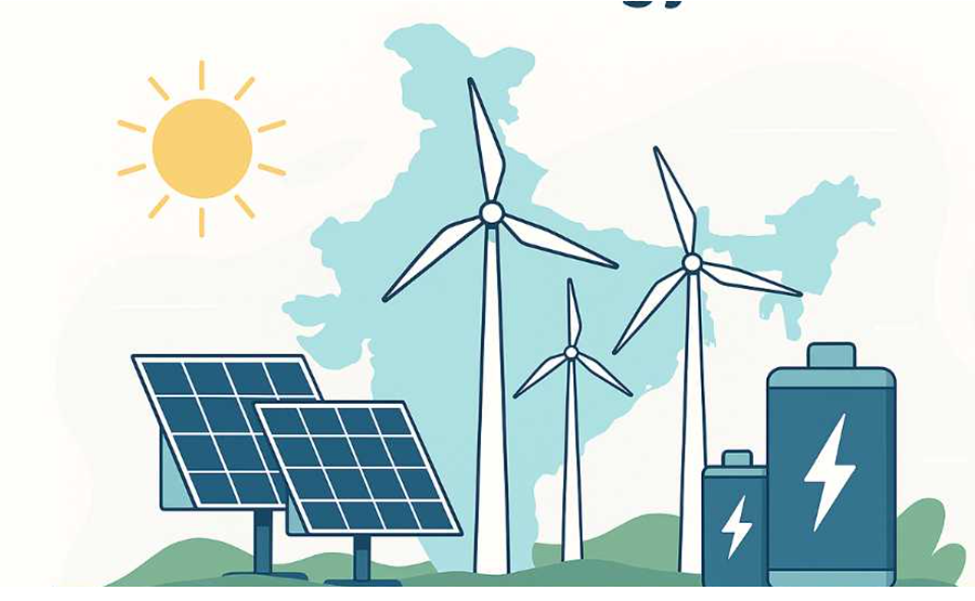
India, with 1.4 billion people and 7.5% growth, is set to become the world’s largest electricity consumer.
Coal supplies 75% of power, ensuring stability and energy security.
Solar capacity surged from 4 GW to 140 GW; renewables may surpass fossil fuels by 2050.
Storage expansion (7 GW to 72 GW) and green hydrogen are critical.
Strategy balances growth, reliability, and climate goals.
India stands at the center of the global energy conversation. With a population of 1.4 billion people and an economy growing at roughly 7.5% annually, the country’s energy demand is rising at an extraordinary pace. In fact, India is on track to become the world’s largest electricity consumer in the coming decades.
The challenge? Powering rapid economic growth while managing climate commitments and ensuring energy security for one of the world’s most populous nations.
A Coal-Heavy Present
Today, coal remains the backbone of India’s power system, supplying about 75% of the country’s electricity. Renewables make up the remaining share. While India is rapidly expanding its clean energy capacity, fossil fuels continue to play a critical role in keeping the lights on.
Energy security remains a top priority. India has not hesitated to purchase discounted oil from Russia despite international criticism—underscoring its pragmatic approach to securing affordable energy supplies. The government openly acknowledges that coal will continue to support economic expansion, particularly as electricity demand surges.
Over the past decade, coal and gas capacity has increased significantly—from 81 gigawatts to 250 gigawatts—to maintain grid stability and ensure uninterrupted supply to homes and businesses.
A Renewable Revolution in Motion
At the same time, India is undergoing one of the fastest renewable energy expansions in the world.
Solar power, in particular, has seen explosive growth. In just ten years, installed solar capacity has jumped from 4 gigawatts to 140 gigawatts, making it the country’s fastest-growing energy sector.
The long-term vision is ambitious: renewables are expected to surpass fossil fuels by 2050, although some analysts caution that this timeline may prove optimistic. Still, the trajectory is clear—India is steadily pivoting toward a greener energy mix.
The government plans to add 250 gigawatts of renewable energy capacity in the next five years, even as it simultaneously plans to add 100 gigawatts of coal capacity. This dual-track approach reflects a balancing act between sustainability and reliability.
The Storage Challenge
Scaling renewable energy is only part of the equation. Solar and wind are intermittent, meaning energy storage is critical to ensuring consistent supply.
India aims to increase its energy storage capacity from 7 gigawatts to 72 gigawatts over the next decade. Expanded battery storage will allow the country to capture solar energy during the day and deploy it at night, improving grid reliability and maximizing clean energy use.
Green hydrogen is also expected to play a transformative role—especially in decarbonizing heavy industries like cement, steel, and textiles, which are central to India’s economy.
Industry Steps In
Private industry is helping drive this transformation.
Dr. Faruk Patel, Chairman and Founder of KP Group in Surat, is a vocal advocate for renewable energy. He frames the energy transition not just as an economic opportunity but as a moral responsibility:
“The world we have is not inherited from our ancestors; it’s borrowed from our kids and future generations.”
KP Group’s renewable energy division designs and installs rooftop and ground-mounted solar plants, along with energy storage solutions for residential, commercial, and industrial clients. In Surat, the company is working with diamond factories that operate entirely on green energy—demonstrating that even energy-intensive industries can transition successfully.
Powering Heavy Industry with Renewables
India’s next frontier is clear: decarbonizing heavy industry.
Cement, steel, and textile manufacturing are pillars of the national economy—and major energy consumers. Moving these sectors toward renewable energy will require not just more solar and wind power, but also expanded storage, grid modernization, and alternative fuels like green hydrogen.
The Balancing Act
India’s energy transition is neither purely green nor purely fossil-fuel-driven. It is a carefully calibrated strategy designed to:
Satisfy a rapidly growing population
Support industrial expansion
Maintain grid stability
Strengthen energy security
Advance climate commitments
In the near term, coal and renewables will coexist. Coal additions help optimize grid infrastructure and ensure reliability, while massive investments in renewables and battery storage lay the groundwork for a cleaner future.
A Gradual but Decisive Shift
Make no mistake: the direction is clear. While coal remains dominant today, the momentum behind renewable energy is powerful and accelerating.
India’s energy journey will likely define global climate progress in the coming decades. If the country can successfully balance growth, stability, and sustainability, it may offer a blueprint for other developing nations facing the same dilemma.
The transformation won’t happen overnight—but it is undeniably underway.


Comments