


'Culture, Trade, Trust': China New Momentum In India Ties
Updated: Feb 13

Ambassador Xu Feihong signaled renewed momentum in India–China relations during Spring Festival events.
He highlighted deep civilisational and cultural links, citing heritage and academic exchanges.
Both nations share values of harmony, self-reliance, and support for the Global South.
Bilateral trade hit a record $155.6 billion in 2025, with strong export growth.
Resumed travel, pilgrimages, and flights are boosting people-to-people ties.
China’s Ambassador to India, Xu Feihong, used the celebrations marking the Spring Festival and Chinese New Year to highlight what he described as fresh energy in relations between New Delhi and Beijing. His remarks blended cultural reflections with economic indicators and diplomatic developments, pointing to a gradual rebuilding of ties between the two neighbouring powers.
Addressing an audience comprising Chinese and Indian attendees, the ambassador spoke of the deep civilisational connections shared by the two countries. Referring to his recent visits to the Ajanta and Ellora caves—globally renowned UNESCO World Heritage sites—Xu said the monuments offered visible evidence of historical exchanges, particularly through the spread and evolution of Buddhist thought and art across Asia.
He also recalled his time at Santiniketan in West Bengal, associated with Nobel laureate Rabindranath Tagore, and his interactions with faculty and students at the Chinese language and culture departments of Visva-Bharati University. These experiences, Xu noted, reinforced his belief in the lasting cultural bonds and shared spiritual traditions that continue to link the two societies.
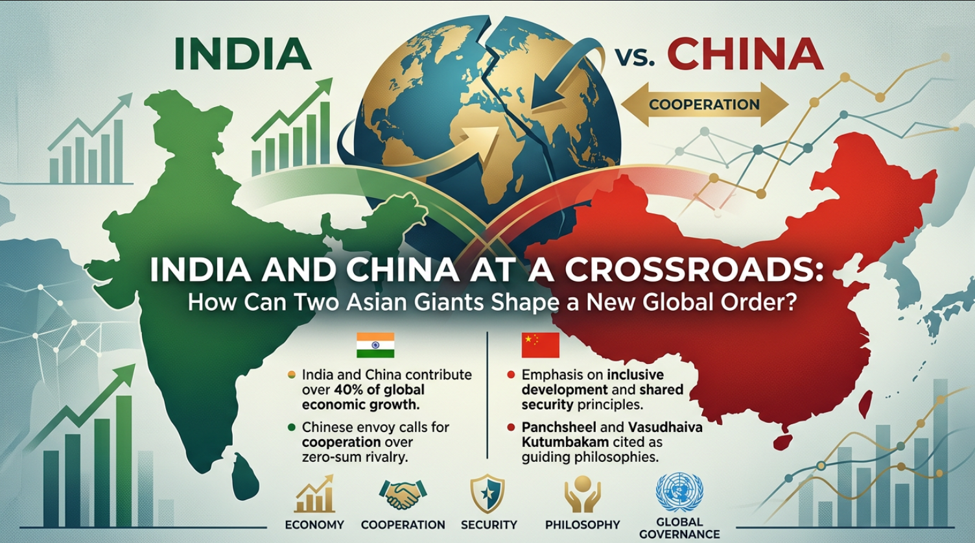
Drawing comparisons between cultural values and national philosophies, the envoy observed that both India and China place strong emphasis on harmony, unity, and self-reliance, whether at the level of families or nations. He suggested that China’s outlook on global harmony and India’s broader international aspirations intersect in their support for multilateral cooperation and the development agenda of the Global South.
From a strategic standpoint, Xu said Beijing regards New Delhi as a partner in cooperation and a source of development opportunity. He called for closer alignment of development strategies, expanded practical collaboration, and stronger people-to-people exchanges to deepen mutual understanding. Enhancing multilateral coordination, he added, would help both sides unlock shared benefits in the years ahead.
Economic ties featured prominently in his address. Xu disclosed that bilateral trade reached an all-time high of $155.6 billion in 2025, representing growth of more than 12% compared to the previous year. He also highlighted a nearly 10% rise in Indian exports to China, describing this trend as a sign of significant untapped potential in the economic relationship.
The ambassador further pointed to steps taken by both governments to revive travel and exchanges. China has reopened the pilgrimage route for Indian devotees to Mount Kailash and Lake Manasarovar, while India has resumed issuing tourist visas to Chinese nationals. The restoration of direct flights between the two countries, he said, is expected to further strengthen people-to-people contact.
Xu also referenced the meeting between President Xi Jinping and Prime Minister Narendra Modi in Tianjin last August, calling it an important moment that helped steer bilateral relations toward improvement. Since then, he noted, interactions across various levels have increased and overall ties have shown steady progress.
Concluding his remarks, the envoy reaffirmed China’s support for multilateralism, free trade, and resilient global supply chains—issues of growing relevance amid global uncertainty. As he extended New Year greetings for the Year of the Horse, Xu’s message underscored a broader theme: that shared culture, expanding economic ties, and renewed diplomatic engagement could together shape the next phase of India–China relations.


Comments