


China Signals Renewed Push for Cooperation with India Across Global Platforms

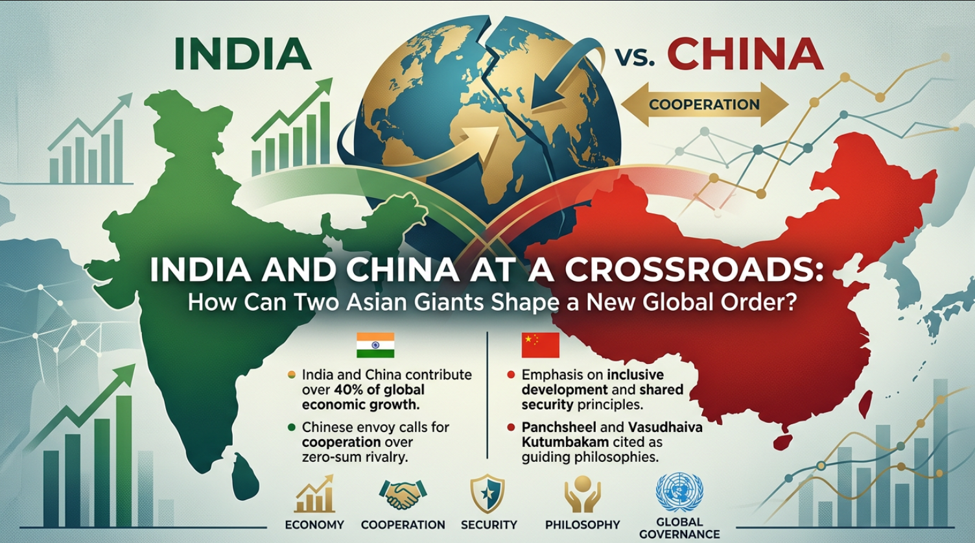
China signals renewed cooperation with India, focusing on Global South and BRICS collaboration.
Leaders stress partnership over rivalry, expanding mutually beneficial engagement.
Cultural diplomacy gains momentum, highlighting yoga, cuisine, and youth exchanges.
Civil aviation links move toward restoration post-Galwan disruption.
Greater coordination urged in BRICS and SCO amid global instability.
China has expressed readiness to deepen engagement with India in support of shared priorities within the Global South and multilateral forums such as BRICS, according to a statement issued by the Chinese Ministry of Foreign Affairs (MoFA) on Thursday, March 26, 2026.
The remarks followed discussions in Beijing between Chinese Foreign Minister Wang Yi and India’s outgoing ambassador, Pradeep Kumar Rawat. Addressing the media after the meeting, MoFA spokesperson Lin Jian described the relationship as one in which both nations should see each other as partners in development rather than strategic competitors.
Lin noted that Beijing is prepared to move forward based on the understanding reached by the leaders of the two countries. He emphasized the importance of viewing one another as collaborators instead of adversaries, broadening practical cooperation across sectors, and working jointly to protect the interests of developing nations. Strengthening coordination in international groupings such as BRICS was also highlighted as a priority. India currently holds the BRICS chair, with the next summit scheduled to take place on Indian soil.
Cultural Ties and People-to-People Exchanges
Echoing the conciliatory tone from Beijing, Chinese Ambassador to India Xu Feihong spoke in New Delhi about the potential for closer bilateral ties. He pointed to the growing interest in India’s yoga traditions, wellness practices, and cuisine within China, suggesting that cultural engagement could serve as a foundation for improved relations.
Ambassador Xu described China and India as permanent neighbors whose futures are intertwined, advocating for a cooperative partnership that enables mutual success — an idea he referred to metaphorically as a coordinated “Dragon-Elephant” partnership. At the same time, he cautioned that certain external actors may prefer strained relations between the two Asian powers, arguing that discord benefits those who seek to exploit divisions.
The ambassador’s comments come amid steps by both governments to restore normal engagement, including efforts to resume direct civil aviation links that were suspended following the June 2020 Galwan Valley clashes.
Engaging the Next Generation
In a speech titled “Bridging Hearts Through Youth: China and India Toward a Shared Future,” Xu underscored the importance of fostering balanced and informed public perceptions. He encouraged greater youth exchanges, inviting young Indians to visit China to observe its development firsthand and contribute to a more nuanced understanding between the two societies.
He also called for expanded cooperation within multilateral frameworks such as BRICS and the Shanghai Cooperation Organisation (SCO), particularly at a time when global politics is marked by instability, protectionist trends, and unilateral policies.
Diplomatic Realignments in New Delhi
As Chinese officials project optimism, India’s Ministry of External Affairs (MEA) is undertaking key diplomatic appointments that could shape the trajectory of bilateral ties. Vikram Doraiswami, currently serving as India’s High Commissioner to the United Kingdom, has been designated as the next ambassador to China. Additionally, Rudrendra Tandon, who previously represented India in Afghanistan, has been appointed Secretary (East) at the MEA — a role central to managing relations across Asia, including with Beijing.
Together, the diplomatic messaging and personnel changes signal a period of cautious recalibration in India-China relations, with both sides publicly emphasizing cooperation, multilateral coordination, and renewed people-to-people contact as pathways toward stabilizing ties.


Comments