


India and China at a Crossroads: How Can Two Asian Giants Shape a New Global Order?
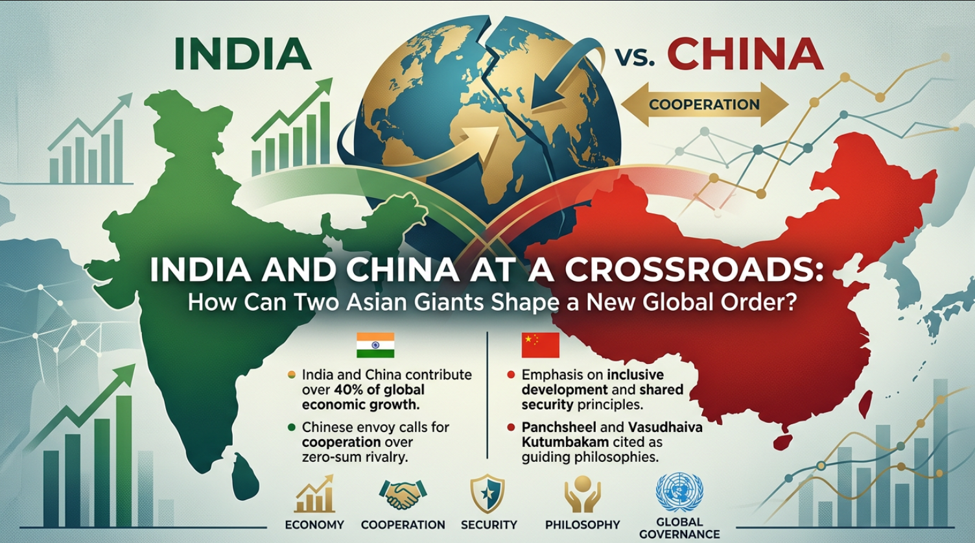
India and China contribute over 40% of global economic growth.
Chinese envoy calls for cooperation over zero-sum rivalry.
Emphasis on inclusive development and shared security principles.
Panchsheel and Vasudhaiva Kutumbakam cited as guiding philosophies.
As the center of global influence steadily tilts toward Asia, the evolving dynamic between India and China is assuming significance far beyond their shared border. The trajectory of ties between the two countries now carries implications for global governance, economic stability and geopolitical balance.
Xu Wei, Consul-General of the People’s Republic of China in Kolkata, recently argued that the combined weight of India and China in the world economy places them in a pivotal role. Together, the two nations — home to the largest populations globally — account for more than 40 percent of global economic expansion. That scale, he suggested, gives them the capacity to influence how international systems evolve in the decades ahead.
Advocates of stronger engagement between New Delhi and Beijing contend that collaboration between the Asian neighbors could provide a counterbalance to unilateral approaches in global politics. By drawing on Asia’s historical traditions of coexistence and mutual respect, they argue, the two powers could help promote a more equitable and representative international order.
Xu emphasized that global advancement requires moving past zero-sum competition. Instead of rivalry that benefits one side at the expense of another, he called for a model rooted in inclusive and sustainable growth. Such a framework, he noted, aligns with India’s long-term national vision leading up to 2047, when the country marks 100 years of independence.
Central to this perspective is the belief that development should not be treated as a selective privilege. Xu underscored that economic progress must be recognized as a universal right, accessible to all nations rather than concentrated among a few.
On matters of security, the Chinese diplomat maintained that lasting peace cannot be built by undermining neighboring states. Durable stability, he argued, depends on mutual confidence, respect for sovereignty, and resolving differences through dialogue. He referenced the Panchsheel principles — the five tenets of peaceful coexistence agreed upon in the 1950s — as a foundation for rebuilding trust and managing disputes constructively.
Cultural diversity, Xu added, should serve as a bridge rather than a dividing line. He linked this idea to India’s philosophical concept of Vasudhaiva Kutumbakam, or “the world is one family,” suggesting that both countries can draw from shared civilizational values to counter narratives that amplify discord. Expanding institutional engagement and fostering dialogue, he argued, would strengthen bilateral understanding.
Ultimately, Xu positioned India and China as key stakeholders in reforming global governance structures, particularly those centered around the United Nations. By acknowledging each other’s core interests and pursuing common economic prosperity, the two Asian powers could contribute meaningfully to a more balanced global system.
As Asia’s prominence rises, the choices made in New Delhi and Beijing will likely resonate far beyond the region. Whether through cooperation or competition, the future of the so-called “Asian century” may hinge significantly on how these two giants navigate their complex relationship.


Comments