


When the Heat Soared, the Sun Delivered: How Solar Power Helped India Meet Record Electricity Demand
India met a record peak demand of 256.1 GW on April 25 without shortages, maintaining exports.
Solar supplied 21% of peak power, contributing 57 GW at critical hours.
Midday solar output touched 81 GW, nearly one-third of total generation.
Installed solar capacity crossed 150 GW by March 2026.
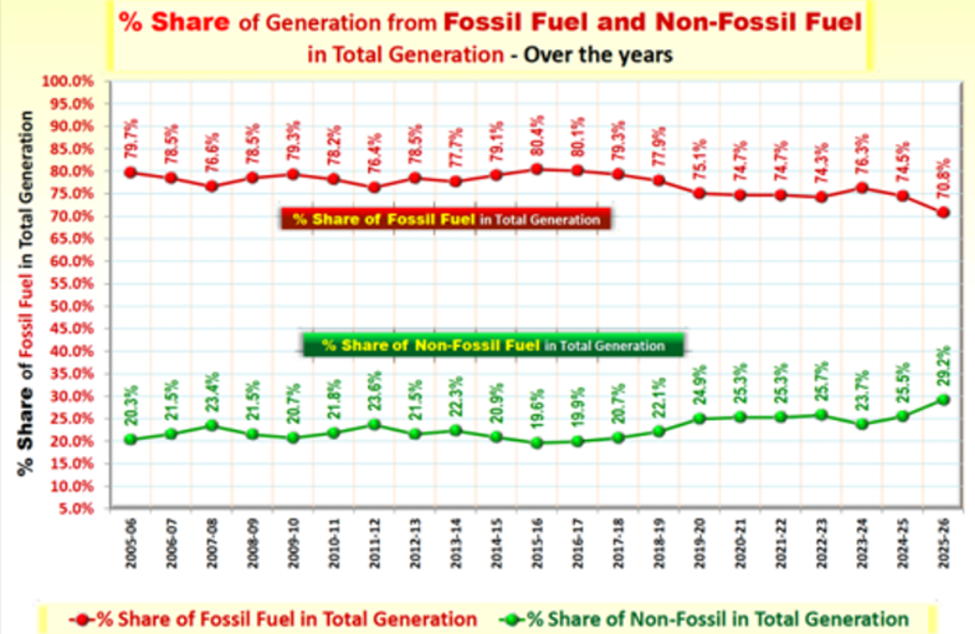
Non-fossil sources now exceed 50% of installed capacity, signalling a structural energy shift.
As temperatures climbed sharply across India this April, so did the country’s appetite for electricity. Air conditioners hummed, fans whirred relentlessly, and cooling systems worked overtime. Yet when India’s power demand surged to an unprecedented 256 gigawatts (GW), the grid held firm — and not solely because of coal-fired plants. Solar energy played a decisive role in keeping the lights on.
On April 25 at precisely 3:38 pm, India recorded its highest-ever peak electricity demand of 256.1 GW. Remarkably, the system met this demand without any shortfall and even continued exporting power to neighbouring nations. Thermal power remained the largest contributor, accounting for 66% of generation. However, solar energy made a striking impact, supplying 21% of the total power mix during peak demand hours. At that moment alone, solar contributed 57 GW — a figure that underscores how integral sunlight has become to India’s energy stability.
Earlier that day, at 12:30 pm, solar generation from utility-scale plants and rooftop systems reached approximately 81 GW. This represented nearly one-third of the country’s total electricity output of 242 GW at the time, according to GRID India, the government entity responsible for operating the national grid.
To put the scale into perspective, one gigawatt equals one billion watts — enough to power 10 million 100-watt bulbs. Just two years ago, on May 30, 2024, India’s peak demand stood at 250 GW. The new milestone marks a significant leap.
An Early and Intense Summer Surge
Electricity demand in India traditionally peaks in June or July, when summer temperatures reach their highest levels. This year, however, the surge arrived in April, pointing to an earlier onset of extreme heat across several regions. The last time such an early annual peak occurred was during 2022–23; typically, the highest demand is recorded in May.
The year-on-year growth is equally striking. April 2025 saw a peak demand of 235 GW. This April, the figure rose to around 256 GW — a jump of more than 20 GW. Between April 1 and April 27, 2026, electricity consumption increased by 8.9% compared to the same period last year, reflecting mounting pressure on the grid as cooling needs intensify.
The Ministry of Power has projected that electricity demand could climb as high as 271 GW during 2026. Officials noted that renewable sources — particularly solar — along with hydro and other flexible resources, were instrumental in meeting peak conditions.
Solar Energy Moves to the Centre Stage
The events of April illustrate a broader transformation underway in India’s energy landscape. Solar power is no longer a peripheral contributor; it is becoming central to managing rising demand while reducing reliance on fossil fuels.
As of March 31, 2026, India’s installed solar capacity crossed 150.26 GW, making it one of the fastest-growing segments in the power sector. Much of this growth came from record capacity additions during the financial year 2025–26, positioning solar as the country’s most rapidly expanding source of electricity.
The impact is visible in generation data as well. During 2025–26, solar power produced 173.52 billion units (BU) of electricity, accounting for approximately 9.46% of total generation and emerging as the largest contributor among renewable sources. Overall, non-fossil fuel sources now make up more than half of India’s installed power capacity — a milestone that signals a structural shift in the energy mix.
Solar’s significance becomes particularly evident during daylight peak hours. Contributing 21.5% of supply at the recent demand high, it played a critical role in balancing the grid when consumption was at its maximum.
Energy analysts observe that India’s power system is entering a new phase, driven by rapid additions in solar and wind capacity. The next frontier lies in strengthening grid infrastructure, expanding storage solutions, and enhancing system flexibility to make the most of low-cost renewable energy.
Policy Push Behind the Progress
India’s solar journey began with the Jawaharlal Nehru National Solar Mission in 2010, but expansion has accelerated dramatically over the past decade. From just a few gigawatts in the early 2010s, the country has surpassed 150 GW in 2026. This aligns with the national target of achieving 500 GW of non-fossil fuel capacity by 2030.
Government-backed initiatives have been central to this momentum. The PM Surya Ghar Muft Bijli Yojana aims to equip one crore households with rooftop solar systems, offering up to 300 units of free electricity per month. As of December 2025, nearly 24 lakh households had adopted rooftop solar under the programme.
In rural India, the PM-KUSUM scheme has focused on solarising agriculture by supporting solar pumps and decentralised plants. By March 2026, more than 21.77 lakh farmers had benefitted from the initiative.
Manufacturing capacity has also received a boost under the Atmanirbhar Bharat initiative. The Production-Linked Incentive (PLI) scheme for high-efficiency solar modules, with an allocation of ₹24,000 crore, seeks to reduce import dependence and strengthen domestic supply chains. Meanwhile, large-scale solar parks targeting 40 GW of capacity have streamlined land acquisition and grid connectivity, speeding up project execution.
A Turning Point for the Grid
India’s seamless handling of record demand reflects more than just operational efficiency; it signals a changing energy narrative. Coal continues to shoulder much of the load, but the Sun is steadily carving out a larger share of the responsibility.
What happened on April 25 was not merely a statistical milestone. It demonstrated that clean energy — particularly solar — is evolving from a supplementary source into a backbone of the national grid. Each installed panel and every rooftop system has contributed to this transition.
As heatwaves grow more intense and electricity demand climbs higher, India’s ability to harness daylight power may prove to be one of its most important strengths.


Comments