


India Surges Ahead: Now the World's Fourth Largest Economy
- InduQin
- May 29, 2025
- 3 min read
Updated: May 30, 2025
India has become the world’s fourth-largest economy, surpassing Japan, with a GDP of USD 4 trillion, according to NITI Aayog CEO BVR Subrahmanyam. The IMF confirms this growth, projecting India’s GDP at USD 4.19 trillion by 2025. Per capita income has doubled over the past decade. India’s economy is expected to grow at 6.2% in 2025-26, driven by rural consumption. NITI Aayog’s vision for 2047 outlines a USD 30 trillion economy, emphasizing reforms and innovation for sustainable development.
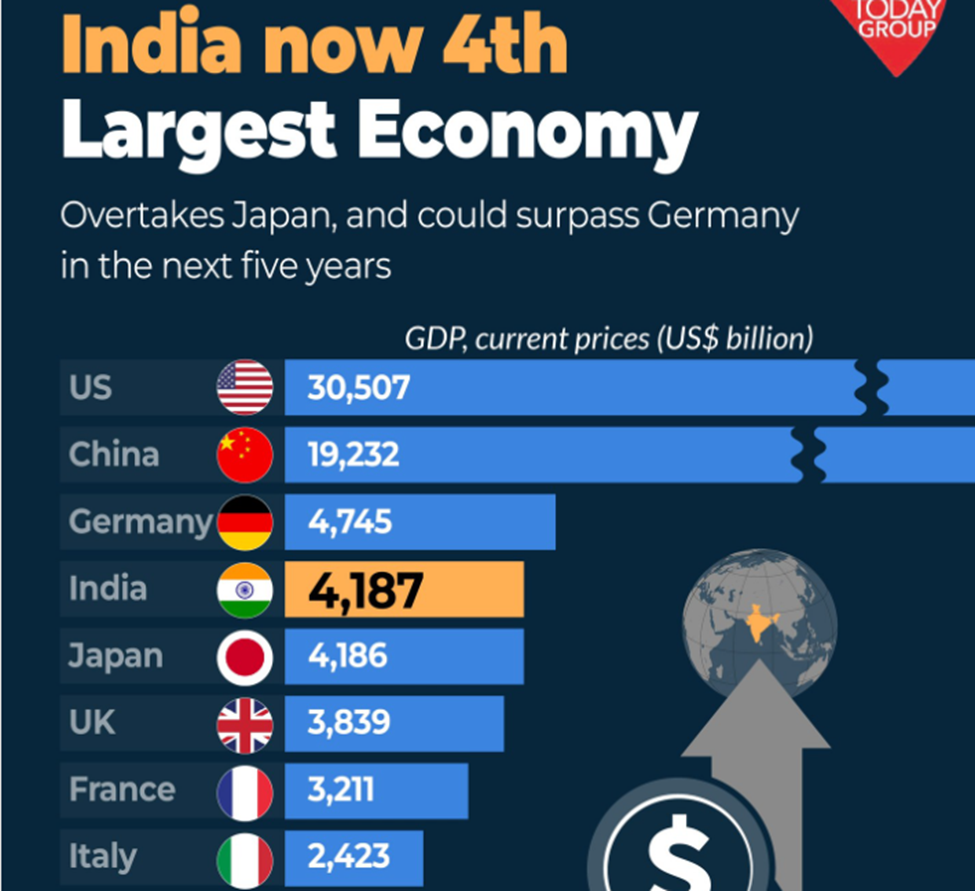
India has achieved a historic milestone by becoming the fourth largest economy globally, surpassing Japan, as announced by NITI Aayog CEO BVR Subrahmanyam. Speaking on the nation's economic progress, Subrahmanyam highlighted that India’s current GDP stands at an impressive USD 4 trillion, signaling its growing economic stature on the world stage.
According to Subrahmanyam, this advancement is supported by a favorable geopolitical and economic environment. “We are now larger than Japan, and only the United States, China, and Germany remain ahead of us," he stated, emphasizing the country's steady rise in global economic rankings. He also expressed confidence that, if current strategies and plans are executed effectively, India is poised to overtake Germany within the next three years to become the third largest economy.
IMF Confirms India’s Economic Momentum
The International Monetary Fund (IMF), in its latest World Economic Outlook (WEO) report, corroborates India’s economic ascent. The report projects India’s GDP at USD 4.19 trillion by 2025, placing it ahead of Japan. This marks a significant leap from 2024, when India held the position of the world’s fifth-largest economy.
Beyond overall GDP, India's progress in per capita income is equally noteworthy. The IMF data reveals that India’s per capita income has doubled over the past decade, rising from USD 1,438 in 2013-14 to an estimated USD 2,880 by 2025.
The IMF also forecasts that India’s economy will grow at 6.2% in fiscal year 2025-26, slightly lower than the earlier estimate of 6.5%. This adjustment reflects global challenges such as trade tensions and economic uncertainties. Despite this moderation, India's growth outlook remains robust, driven by private consumption, particularly in rural regions.
A Decade of Transformation
India’s journey from being labeled one of the "fragile five" economies a decade ago to now being among the top four is a testament to its resilience and strategic reforms. A recent NITI Aayog approach paper titled "Viksit Rajya for Viksit Bharat @ 2047" outlines the vision for India's long-term development. It envisions India as a USD 30 trillion economy by 2047, achieving the status of a high-income country with a per capita income surpassing USD 14,005, as per World Bank criteria.
Building Blocks for a Developed India
To achieve this ambitious vision, NITI Aayog has identified six key building blocks that will serve as the foundation for India’s transformation into a fully developed nation:
Macro-Economic Goals and Strategy: Ensuring financial stability and sustained economic growth.
Empowered Citizens: Enhancing education, healthcare, and social equity.
A Thriving and Sustainable Economy: Promoting industries, sustainable practices, and economic inclusivity.
Technology and Innovation Leadership: Positioning India as a global leader in technological advancements.
A Global Leader, Vishwa Bandhu: Strengthening India’s role in global governance and diplomacy.
Enabling Factors: Improving governance, security, and justice delivery systems.
The paper emphasizes the need for strategic reforms across 26 thematic areas to achieve the vision of Viksit Bharat by 2047.
India’s Global Role and Future Aspirations
India’s rise as an economic powerhouse has far-reaching implications for the global economy. While global growth is projected at a subdued 2.8% in 2025 and 3% in 2026, India’s steady growth trajectory positions it as a beacon of economic stability.
As the nation continues its journey toward becoming a high-income country, its commitment to innovation, sustainability, and empowerment will play a pivotal role in shaping its future. With the right mix of policy interventions and strategic planning, India is well on its way to becoming a global economic leader by mid-century.
This remarkable transformation underscores not just India’s economic potential but also its determination to redefine its place in the world.


Comments