


India’s Venture Capital Revival: A Promising Turn in 2025
- InduQin
- Aug 11, 2025
- 3 min read
India’s venture capital sector is rebounding strongly in 2025 after a slow 2024, raising $3.2 billion so far, surpassing last year’s $2.7 billion. Key players like Accel and A91 Partners are driving momentum, with total fundraising potentially reaching $4.6 billion. Improved startup quality, attractive valuations, and better exit opportunities, including IPOs from firms like Lenskart and Meesho, are fueling growth. India’s macroeconomic stability and rising global investor interest, especially amidst China’s decline, position 2025 as a pivotal year for sustained VC growth.
After a subdued performance in 2024, India’s venture capital (VC) landscape is showing robust signs of resurgence. With improved liquidity, a growing pipeline of high-quality startups, and increased investor confidence, the sector is poised for a significant turnaround.
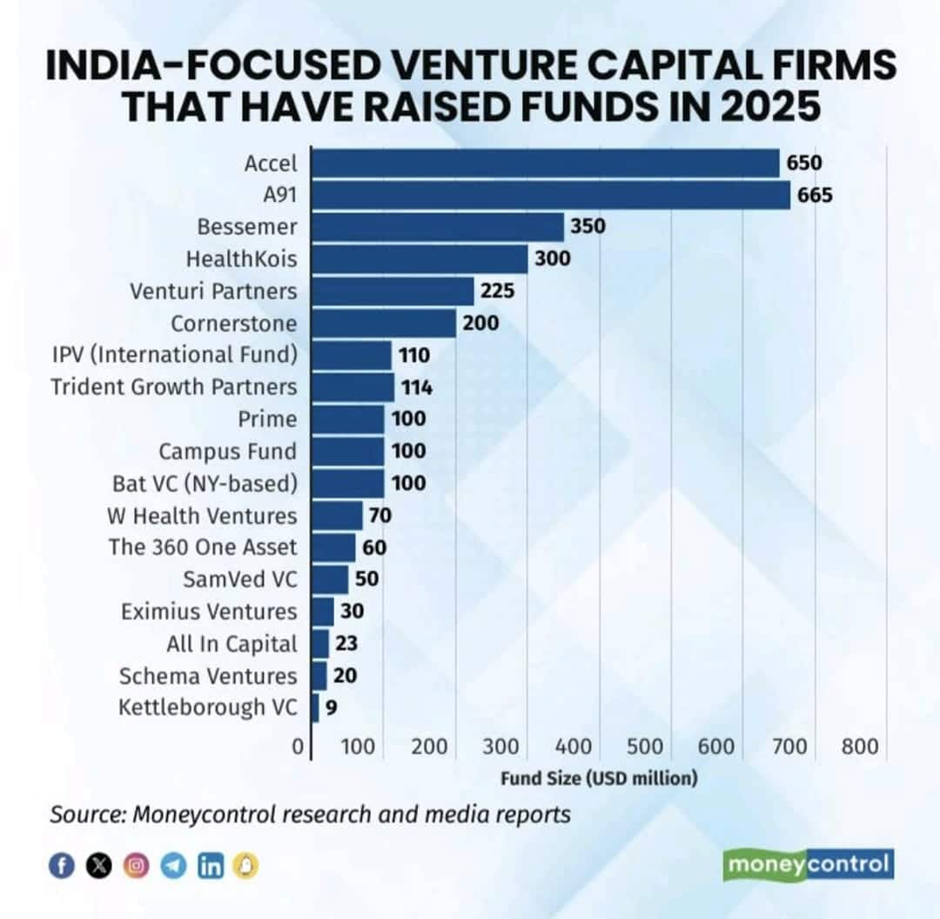
So far in 2025, 18 venture capital firms have collectively raised approximately $3.2 billion, already surpassing the $2.7 billion raised in all of 2024 — a five-year low, according to a joint report by Bain & Company and the Indian Venture and Alternate Capital Association (IVCA). If ongoing fundraising efforts succeed, the total capital raised this year could reach $4.6 billion, exceeding 2023’s $4 billion milestone.
The revival is being spearheaded by both global and domestic firms. Accel has raised $650 million, A91 Partners secured $665 million, and Bessemer Venture Partners closed a $350 million fund. Other contributors include Cornerstone VC with $200 million and Prime Venture Partners with $100 million.
More firms, such as Nexus Venture Partners, Fireside Ventures, and Info Edge Ventures, are actively in the market, seeking additional capital. This renewed interest reflects a decisive break from last year’s sluggish fundraising environment.
Dr. Pankaj Jethwani, Managing Partner at W Health Ventures, which recently announced a $70 million second fund, attributes the shift to improving market conditions. “Fund cycles are kicking in, and limited partners (LPs) are cautiously optimistic about India. With China becoming less favorable for Western LPs, India’s structural advantages — such as a robust engineering talent pool, growing AI capabilities, and a sizable consumer market — are drawing significant attention,” he noted.
Much of the sector’s recovery stems from the quality of startups entering the market. Bessemer Venture Partners, which closed its $350 million India fund earlier this year, highlights the growing presence of startups with sustainable business models and a clear path to profitability.
“India remains a highly attractive investment market, driven by strong macro fundamentals, a thriving digital economy, and a deep talent pool,” said Anant Vidur Puri, Partner at Bessemer Venture Partners. He emphasized that valuations are becoming more attractive, and exit opportunities are improving, further bolstering investor confidence.
Exit Opportunities Gaining Traction
The IPO market has also played a pivotal role in the sector’s rebound. Thirteen startups, including Swiggy, Mobikwik, and Ola Electric, went public in 2024, compared to just five in 2023 and two in 2022. This momentum is expected to carry into 2025, with over 25 startups, such as Lenskart, Meesho, and Urban Company, planning initial public offerings (IPOs).
While some listings have been delayed due to market volatility, several firms have already filed draft red herring prospectuses (DRHPs) and are preparing for imminent launches.
India’s relative macroeconomic stability continues to attract foreign capital. Singapore-based Venturi Partners, for instance, recently launched its $225 million second fund, underscoring the global shift in investor sentiment toward India.
“India has become a net beneficiary of capital moving away from less stable markets,” said Rishika Chandan, Managing Partner at Venturi Partners. She added that India’s strong fundamentals and limited dependence on exports to the US make it a compelling option for LPs reallocating their portfolios.
Domestic LPs, too, are showing renewed interest, though their approach remains discerning, particularly when it comes to governance. “Governance has been a recurring concern, but Indian general partners (GPs) are taking it seriously. Large funds are dedicating significant resources to compliance and governance,” said Dr. Jethwani of W Health Ventures.
With improving liquidity, a steady influx of capital, and a growing ecosystem of high-quality startups, 2025 is shaping up to be a pivotal year for India’s venture capital sector. While the exuberance of 2021 may not return, the current cycle is defined by more substantial and focused investments.
If the momentum in fundraising, IPOs, and secondary markets continues, this year could mark a genuine reset, setting the stage for even stronger growth in 2026.


Comments