


India’s Mounting Reliance on Chinese Industrial Imports Raises Strategic Concerns
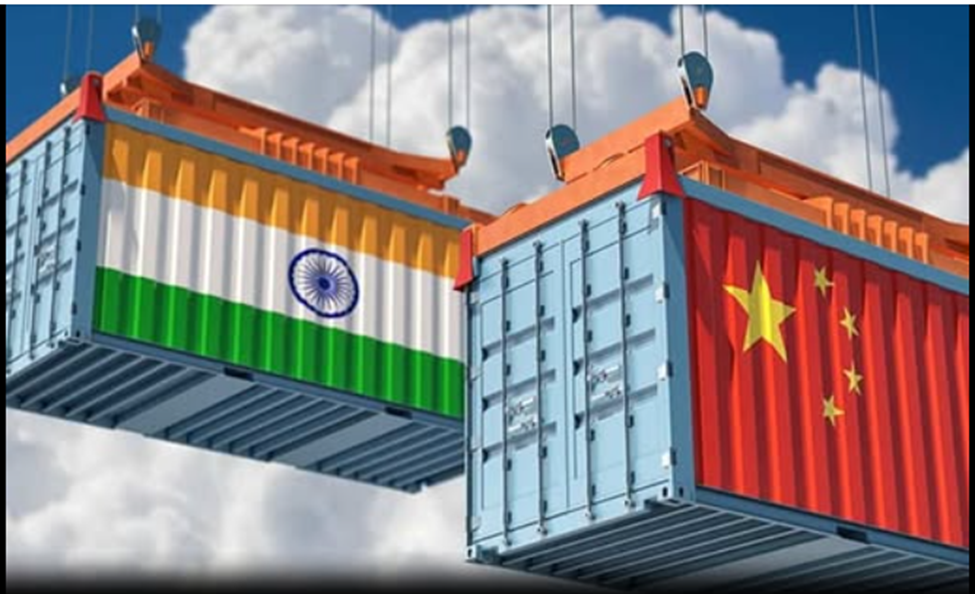
China accounts for 16% of India’s total imports but 30.8% of industrial supplies.
Imports from China doubled to $131.6 billion in FY2026.
Trade deficit widened to $112.1 billion, up 155% in five years.
98.5% of imports are industrial goods.
Heavy reliance in electronics, machinery, chemicals.
GTRI urges diversification and capping single-country dependence below 30%.
India’s expanding trade imbalance with China is no longer merely a matter of importing more goods than it exports. A recent analysis by the Global Trade Research Initiative (GTRI) suggests the issue runs deeper, pointing to a structural dependence on Chinese industrial supplies that underpin much of India’s manufacturing sector.
Although Chinese products account for roughly 16% of India’s overall imports, their presence in the country’s industrial supply chain is far more pronounced. According to the report, China provides nearly 30.8% of India’s industrial imports, making it an essential supplier in key sectors such as electronics, pharmaceuticals, and clean energy.
Trade figures for 2025–26 illustrate the scale of the relationship. India’s total imports reached $774.98 billion during the financial year, with shipments from China valued at $131.63 billion. Over the past five years, purchases from China have more than doubled—from $65.2 billion in FY2021 to $131.6 billion in FY2026.
By contrast, India’s exports to China have shown limited growth. Outbound shipments stood at $19.5 billion in FY2026, still trailing the $21.2 billion recorded in FY2021. This imbalance has driven India’s trade deficit with China to $112.1 billion in FY2026—a sharp 155% increase compared to the $44 billion gap five years earlier.
Industrial Goods Dominate the Trade Flow
GTRI’s findings indicate that the nature of imports is just as significant as their volume. An overwhelming 98.5% of India’s imports from China consist of industrial goods, while consumer or non-industrial items make up less than 1.5%. This underscores how deeply embedded Chinese components are within India’s production ecosystem.
The reliance is particularly concentrated in four major categories: electronics, machinery, computers, and organic chemicals. Combined, these sectors accounted for $82.6 billion, or about 66% of India’s total imports from China.
China supplies 43% of India’s electronics imports, 40% of machinery and computer imports, and 44% of organic chemical imports. These materials are not optional purchases but vital inputs that feed directly into manufacturing processes across industries.
Indian manufacturers depend heavily on Chinese-sourced components such as electronic parts, electric vehicle batteries, solar panels, active pharmaceutical ingredients (APIs), and specialty chemicals. As India works to strengthen its export capabilities, these supply chain linkages mean production remains closely tied to Chinese inputs.
Strategic and Economic Risks
The report cautions that such concentrated dependence presents clear vulnerabilities. Industries including pharmaceuticals, electronics, and renewable energy could face significant disruptions in the event of geopolitical tensions, trade disputes, or supply chain interruptions.
GTRI also expressed concern over the possibility of relaxed investment rules for Chinese firms. It noted that companies, particularly in the electric vehicle space, could increase their footprint in India through local assembly operations while continuing to import high-value components from China. This model may limit genuine domestic value addition and intensify competition for Indian manufacturers.
Charting a Way Forward
To mitigate these risks, GTRI recommends strengthening domestic manufacturing capabilities and broadening sourcing strategies. Building resilience, the think tank argues, requires reducing overdependence on any single country—especially in strategically important sectors.
A practical benchmark, according to the report, would be to cap reliance on one nation at below 30% of imports in critical industries. Achieving this would demand coordinated policy efforts, targeted incentives for domestic production, and diversification of supply chains.
As India pursues its ambition of becoming a global manufacturing hub, the challenge will lie not only in boosting exports but also in ensuring that the foundations of its industrial growth are secure, diversified, and less vulnerable to external shocks.


Comments