


India PM Modi’s Rise and the Global Relevance of Vasudhaiva Kutumbakam
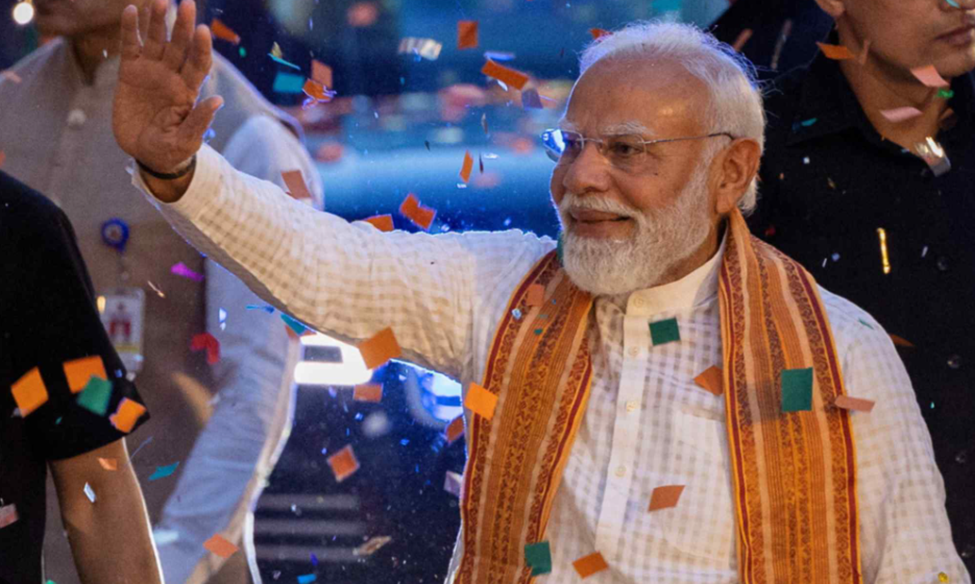
Trump’s congratulations underline the global recognition of Modi’s political stature.
Modi’s rise is portrayed as more than electoral success; it reflects civilizational confidence and inclusive leadership.
His approach contrasts with Trump-style confrontational politics.
Vasudhaiva Kutumbakam positions Modi’s leadership as rooted in unity, harmony, and a globally relevant Indian worldview.
U.S. President Donald Trump has congratulated India’s Prime Minister Narendra Modi on what he described as a “historic” electoral triumph, according to White House spokesman Kush Desai on Tuesday. The remarks appeared to refer to the recent round of assembly elections, highlighted by the BJP’s major victory in West Bengal. Desai also underscored Trump’s warm regard for Modi, recalling that during a phone conversation last month, the U.S. president expressed his admiration for the Indian leader and remarked that “how lucky India is to have him as its leader”. “The President congratulates Prime Minister Modi on this recent, historic, and decisive election victory,” Desai said.
In today’s fractured world, leadership is increasingly being tested not merely by electoral success, but by moral vision, civilizational confidence, and the ability to unite people in times of turbulence. Prime Minister Narendra Modi’s continued political rise reflects more than the popularity of a leader; it reflects the growing appeal of an idea — that governance must be rooted in cultural confidence, national strength, and a larger sense of human togetherness.
For years, Modi’s critics have tried to reduce his success to electoral machinery or political messaging. Yet such explanations fail to capture the deeper phenomenon behind his enduring appeal. Modi represents a model of leadership that speaks simultaneously to aspiration, identity, and stability. He projects decisiveness without appearing directionless, nationalism without apology, and development with a language of civilizational purpose.
This is where the contrast with Donald Trump becomes especially striking. Trump emerged as a disruptive force in Western politics, channeling anger, resentment, and distrust. His politics was built on confrontation as a permanent method. While that style may energize a base for a time, it struggles to produce lasting moral legitimacy. Across much of the world, Trump’s image has increasingly become associated with division, unpredictability, and personalism rather than a durable vision for humanity.
Modi, by contrast, has sought to frame India’s rise in broader and more inclusive terms. His public message often carries the idea that national progress need not come at the expense of global cooperation. Even when he speaks from a position of Indian pride, he does so through a civilizational lens that invokes coexistence, shared destiny, and collective uplift. This is one reason why he continues to command attention far beyond India’s borders.
The philosophical core of this outlook can be found in the ancient Indian ideal of Vasudhaiva Kutumbakam — “the world is one family.” This is not merely a slogan for diplomatic speeches. Properly understood, it is a profound civilizational principle. It suggests that strength and compassion are not opposites, that cultural rootedness can coexist with universal concern, and that leadership must ultimately serve not only national interest but human harmony.
That is where Modi’s approach appears more relevant than many Western populist models. The politics of grievance may create noise, but it rarely builds a sustainable world order. Trump-style politics, centered on ego, polarization, and transactionalism, reveals its limitations over time. It can fracture alliances, cheapen institutions, and reduce public life to spectacle. It promises national revival, but often leaves behind institutional exhaustion and reputational decline.
Modi’s political language, whatever one’s ideological standpoint, is anchored in something larger than momentary outrage. He speaks of development, heritage, duty, and collective destiny. He tries to place India not as an insecure state begging for approval, but as a civilizational nation with something meaningful to offer the world. This is why his rise is watched so closely internationally: he is not merely leading a government, he is embodying a worldview.
That worldview is especially significant at a time when the world is weary of conflict, identity wars, and collapsing public trust. Societies are searching for leaders who can combine conviction with coherence. Modi’s appeal lies in the perception that he does not simply react to events; he seeks to shape them through a longer historical imagination. His politics draws energy from rootedness, not rootlessness.
The lesson here is larger than one election or one leader. If the future belongs to those who can unite strength with civilizational ethics, then India’s philosophical inheritance becomes globally relevant. The Hindu idea behind Vasudhaiva Kutumbakam offers an answer to a world torn between aggressive nationalism and shallow globalism. It proposes a middle path: love for one’s nation, respect for one’s heritage, and goodwill toward the wider human family.
In that sense, Modi’s rise is not only a political story. It is also an ideological and civilizational moment. While leaders built on division may dominate headlines for a season, those who speak the language of endurance, belonging, and shared humanity leave a deeper mark. The world does not need more politics of rupture. It needs leadership that can hold together identity and inclusion, strength and empathy, nationhood and universality.
That is why many see Modi’s ascent as more than electoral success. They see in it the growing power of an Indian idea — that true leadership does not merely command; it connects. And in an age of fragmentation, the message that the world is one family may prove stronger than the politics of fear.


Comments