


India First, World Later: Why More Students Are Rethinking the Overseas Education Route
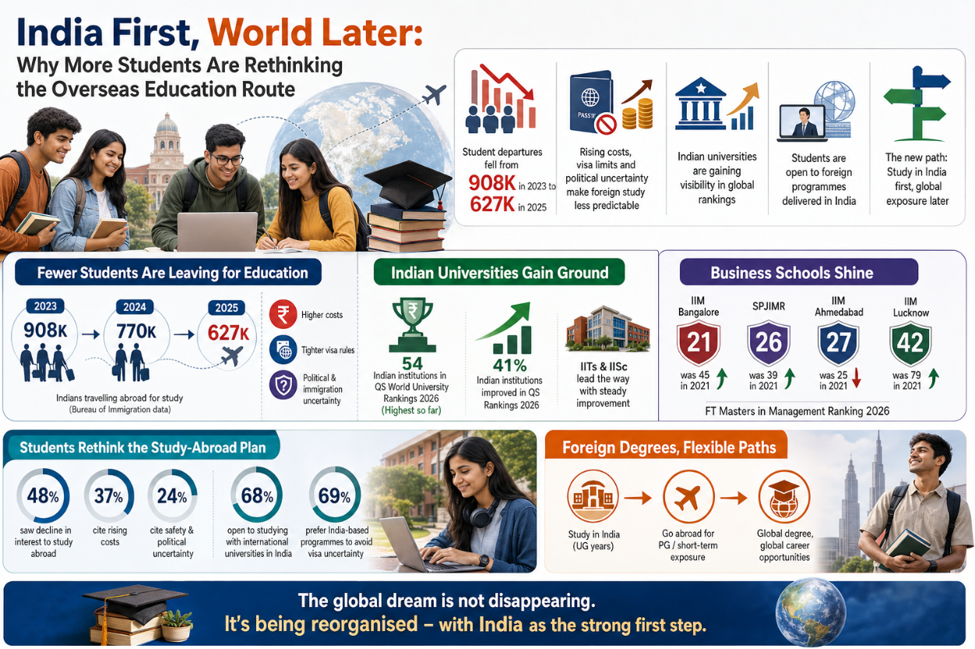
Indian student departures for education fell from 908,364 in 2023 to 626,606 in 2025.
Rising costs, visa limits and political uncertainty are making foreign study less predictable.
Indian universities are gaining visibility in global rankings, especially IITs, IISc and business schools.
Students are increasingly open to foreign university programmes delivered in India.
The emerging model is domestic study first, overseas exposure later.
For decades, studying abroad after school was seen by many Indian families as the most reliable path to a high-quality education, international exposure and a career that could stretch beyond national borders. A degree from a foreign university often carried prestige, better networking opportunities and the possibility of settling overseas.
That calculation is now changing. The overseas education route has become more expensive, more uncertain and more exposed to policy shifts in destination countries. At the same time, Indian universities are beginning to strengthen their standing, giving students a more credible reason to consider staying in the country for at least the first stage of higher education.
The rising cost of tuition and living expenses, a weaker rupee and tighter visa policies in popular study destinations have made families reassess the financial risk of sending students abroad. Immigration uncertainty and geopolitical tensions have further complicated a decision that already involves a major long-term commitment.
India’s higher education system is entering this period with greater confidence. A select group of universities and institutes has improved its global profile, built stronger research credentials and performed better in disciplines such as engineering, science, technology and management. In parallel, foreign universities are preparing to bring more programmes and campuses to India.
Together, these developments are creating a new moment for Indian higher education. As the foreign study pathway becomes less predictable, India is becoming a more serious starting point for students with global ambitions.
Fewer Students Are Leaving for Education
The number of Indians travelling abroad for study has declined sharply in recent years. According to Bureau of Immigration data shared with Parliament, 908,364 Indians listed “study” or “education” as their purpose of travel in 2023. That figure fell to 770,127 in 2024 and further to 626,606 in 2025.
These numbers do not directly represent confirmed university enrolments overseas. However, they offer a clear signal that education-related travel from India has slowed.
The decline comes as students face higher education costs and more restrictive migration policies in major destinations. Families are also weighing the risk of uncertain post-study work options, which are often central to the financial logic of going abroad.
Canada introduced a national cap on study permit applications in 2024. The Canadian government said the measure was aimed at stabilising the international student population, with the capped group expected to be 28% lower than in 2023.
The United Kingdom has also made changes to its Graduate visa. Students applying by December 31, 2026 can still stay for two years after graduation. Those applying from January 1, 2027 will be eligible for an 18-month stay, except doctoral graduates, who will continue to receive three years.
In the United States, applicants for F, M and J visas are already subject to online presence review. The US Department of State has also expanded social media screening and asked applicants in multiple visa categories to keep their social media profiles public.
These changes have made the overseas education decision more complex. A foreign degree may still be attractive, but the route to financing it and converting it into work experience abroad has become less certain.
Indian Universities Gain Ground in Rankings
While outbound education has become more difficult, Indian institutions have started to show stronger performance in international rankings.
The QS World University Rankings listed 54 Indian institutions in 2026, India’s highest representation so far. QS also reported that 41% of Indian institutions improved their positions that year.
The improvement is most visible among the Indian Institutes of Technology and the Indian Institute of Science. IIT Bombay rose from 149th in the QS 2024 rankings to 118th in 2025. IIT Delhi became India’s highest-ranked institution in the 2026 edition at 123rd. IIT Kanpur also moved upward, rising from 263rd to 222nd between the 2025 and 2026 rankings.
The Times Higher Education World University Rankings have also shown India’s growing presence. In 2026, India had the second-largest number of ranked universities globally, behind only the United States. IISc Bengaluru was placed in the 201–250 band. However, most Indian institutions continue to remain outside the global top 200.
This shows that the progress is real but uneven. India is appearing more frequently in global rankings, and some leading institutions are moving up. Yet the strongest gains remain concentrated among a limited set of elite institutions and specific subject areas.
Business Schools Show Faster Progress
Indian management education has recorded especially notable gains in global rankings.
In the Financial Times Masters in Management ranking, IIM Bangalore moved from 45th place in 2021 to 21st in 2026, a rise of 24 places. IIM Ahmedabad moved slightly down from 25th to 27th. SPJIMR improved from 39th to 26th, while IIM Lucknow climbed from 79th to 42nd, gaining 37 places.
The latest FT ranking included 14 Indian programmes, with five of them placed in the global top 50. Indian business schools performed strongly on salary growth, career progress, employer reputation and value for money.
Their main weakness continues to be international diversity. Compared with many global business schools, Indian institutes still attract fewer international students and faculty members. Even so, the career outcomes reported by leading Indian management schools are strengthening their appeal among domestic students.
Across global rankings, the broader pattern is clear. India’s higher education footprint is expanding. Its best institutions are more visible internationally, and its top business schools are delivering increasingly competitive career outcomes. But the improvement remains concentrated in engineering, technology, science and management rather than spread evenly across the system.
Students Rework the Study-Abroad Plan
The changing mood is also visible among students.
The Emeritus Gen Z Outlook 2026 report, based on a survey of 1,010 Indians aged 15 to 28 across major cities, found that interest in studying abroad has weakened among many young people. Of those considering overseas education, 48% said their interest had declined over the previous year.
Among respondents whose interest had fallen, 37% pointed to rising costs, while 24% cited safety and political uncertainty. Among those who still wanted to study abroad but had reservations, 40% identified cost as a major concern and 32% cited visa and immigration rules.
The survey also found that India is increasingly being seen as a place where students can access international education without immediately moving overseas. About 68% of respondents said they were likely or extremely likely to study with an international university operating in India. Nearly three-fourths believed that an India-based international programme could offer exposure to global teaching styles and high academic standards.
The preference was even stronger among students closer to making education decisions. Among undergraduate students and those preparing for postgraduate study, 69% said they preferred an India-based international programme over going abroad because it helped avoid visa uncertainty.
Among students preparing for postgraduate education, 38% said an international programme delivered in India would be their first choice.
This suggests that students are not abandoning global education. Instead, they are reconsidering the timing and structure of it.
Foreign Degrees Become More Flexible
The emerging model is not simply about choosing India over foreign universities. It is about combining the two in a more flexible and financially cautious way.
Students may complete three or four years of undergraduate education in India and then pursue a master’s degree overseas. Others may enrol in a foreign university’s India campus. Some may choose hybrid programmes that include domestic study along with a semester or short-term exposure abroad.
This model can reduce the cost of spending several full years overseas while still offering access to foreign credentials, international networks and potential global career pathways.
The Cambridge Destination Survey 2025 also points to growing confidence in domestic higher education. Among the Indian schools surveyed, 56% of domestic students applied to Indian universities in 2024, up from 52% in 2023 and 47% in 2022.
Cambridge cited better domestic standards, affordability and flexibility as factors influencing student decisions. Preferred Indian institutions included Ashoka University, FLAME University, VIT, Manipal Academy of Higher Education, NMIMS, Christ University, O.P. Jindal Global University and the University of Mumbai.
Foreign universities are also beginning to adjust to this demand. The Indian government has said that 14 foreign higher education institutions have received letters of intent to set up campuses in India. Five universities from Australia and the UK have received approvals to establish offshore campuses in GIFT City.
These developments could make India a stronger hub for international education delivered locally.
A New Education Pathway: India First, Global Later
The shift now underway does not mean Indian students have stopped valuing foreign education. Rather, they are becoming more selective about how and when they pursue it.
For many, the future path may involve completing an undergraduate degree in India before moving abroad for postgraduate study. For others, it may mean choosing a foreign university campus in India or a joint programme that offers global exposure without the full cost and risk of relocating immediately.
The old formula was simple: leave early to go global. The new approach may be more layered: build a foundation in India, then use that base to access the world.
This gives Indian higher education a rare opportunity. Improved rankings have made domestic institutions more credible, while rising foreign costs and immigration uncertainty have made them more relevant.
The challenge now is to broaden this progress beyond a small cluster of IITs, IISc and leading business schools. If more Indian universities can improve quality, research, faculty strength and international collaboration, the country could become not only a fallback option but a preferred starting point.
India’s higher education moment has arrived at a time when many traditional study destinations are becoming more inward-looking. For Indian students, the global dream is not disappearing. It is being reorganised — with India increasingly becoming the first step toward it.


Comments