


India Finds Its Semiconductor Opening as Global Chip Supply Chains Shift
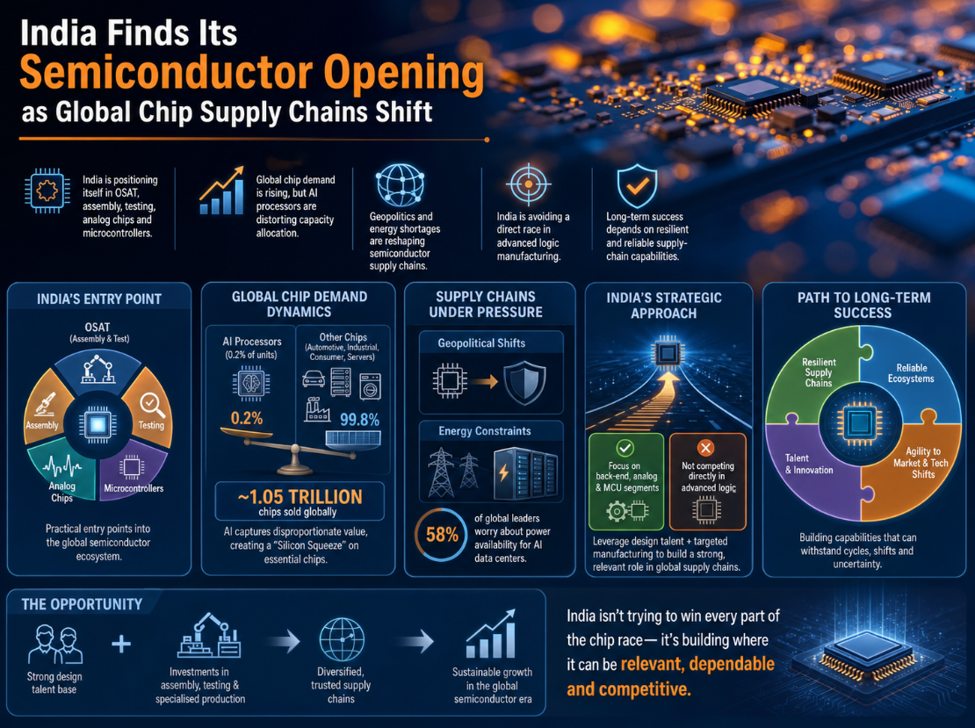
India is positioning itself in OSAT, assembly, testing, analog chips and microcontrollers.
Global chip demand is rising, but AI processors are distorting capacity allocation.
Geopolitics and energy shortages are reshaping semiconductor supply chains.
India is avoiding a direct race in advanced logic manufacturing.
Long-term success depends on resilient and reliable supply-chain capabilities.
India is increasingly being viewed as a strategic location for back-end semiconductor operations, as global chip supply chains adjust to geopolitical pressure, changing demand patterns and growing infrastructure constraints linked to artificial intelligence.
Rather than trying to compete immediately in every part of the semiconductor value chain, India is focusing on areas such as outsourced semiconductor assembly and test, commonly known as OSAT, along with chip assembly, testing, specialised analog production and microcontrollers. These segments are seen as practical entry points into the global semiconductor ecosystem, especially as countries and companies look to diversify production beyond existing hubs.
The global semiconductor industry is undergoing a period of major transition. The sector is expected to grow to about US$1 trillion by 2030, but that expansion is not evenly distributed. A small class of advanced processors used for generative AI is capturing a disproportionate share of industry value, even though these chips represent only 0.2 per cent of total physical units sold.
At the same time, most of the world’s chip demand continues to come from lower-cost components. Around 1.05 trillion chips are sold globally, with many used in automobiles, standard servers, consumer appliances and industrial equipment. These chips may not attract the same attention as AI processors, but they remain essential to the functioning of the wider economy.
This imbalance has created what some in the industry describe as a “Silicon Squeeze”. As more investment and manufacturing capacity is directed toward high-value AI hardware, pressure builds on the supply of lower-margin but widely used components. For sectors such as automobiles and industrial manufacturing, shortages in these everyday chips can still cause serious disruption.
The industry is also being reshaped by geopolitical concerns. For decades, semiconductor supply chains were built around efficiency, cost and specialisation. That model is now changing as governments seek greater control over critical technologies. Policies such as the US CHIPS Act and India’s Semiconductor Mission reflect this shift toward national and regional semiconductor security.
As a result, advanced logic and packaging capabilities are increasingly being concentrated in locations such as North America, Japan and Taiwan. Countries are no longer relying solely on globally optimised supply chains; they are also trying to secure domestic or trusted access to key parts of chip production.
A second constraint is emerging alongside geopolitics: electricity supply. The rapid expansion of AI data centres is placing significant pressure on energy grids. A recent sentiment analysis found that 58 per cent of global leaders are worried about whether large cloud and technology companies can secure enough power for planned AI data centre rollouts. This concern adds another layer of complexity to semiconductor and digital infrastructure planning.
For India, these global shifts create an opportunity. Instead of entering the most expensive and technologically demanding race for leading-edge logic chips, the country is carving out a more targeted role. Back-end semiconductor operations, analog components and microcontrollers are closely linked to automotive, industrial and electronics markets, all of which are expected to remain important even as AI dominates headlines.
India’s established pool of chip design talent gives it an additional advantage. The country already plays a meaningful role in semiconductor design and engineering services. By combining this talent base with investments in assembly, testing and specialised production, India can build a more complete presence in the semiconductor value chain.
The approach also reduces the risk of competing directly with deeply entrenched global leaders in advanced chip fabrication. Leading-edge fabs require enormous capital investment, highly specialised technology and long development timelines. By contrast, OSAT and related back-end activities offer India a more realistic path into advanced manufacturing while still serving critical global markets.
However, the opportunity is not without challenges. The semiconductor sector remains cyclical, and current growth is heavily influenced by AI-related investment. Capital expenditure in memory chips is rising to close near-term supply gaps, but the industry could face a correction later in the decade if AI-related revenues do not match the scale of infrastructure spending.
For India, success will therefore depend not only on attracting investment but also on building durable and reliable supply-chain capabilities. The country must develop ecosystems that can withstand demand swings, technology shifts and geopolitical uncertainty.
India’s semiconductor strategy is not about winning every part of the chip race at once. It is about identifying where the country can become relevant, dependable and competitive. In a world where supply chains are fragmenting and demand is becoming more uneven, that focused approach may give India its strongest opening yet in the global semiconductor industry.


Comments