


From Groceries to Getaways: How India’s Spending Habits Are Being Rewritten
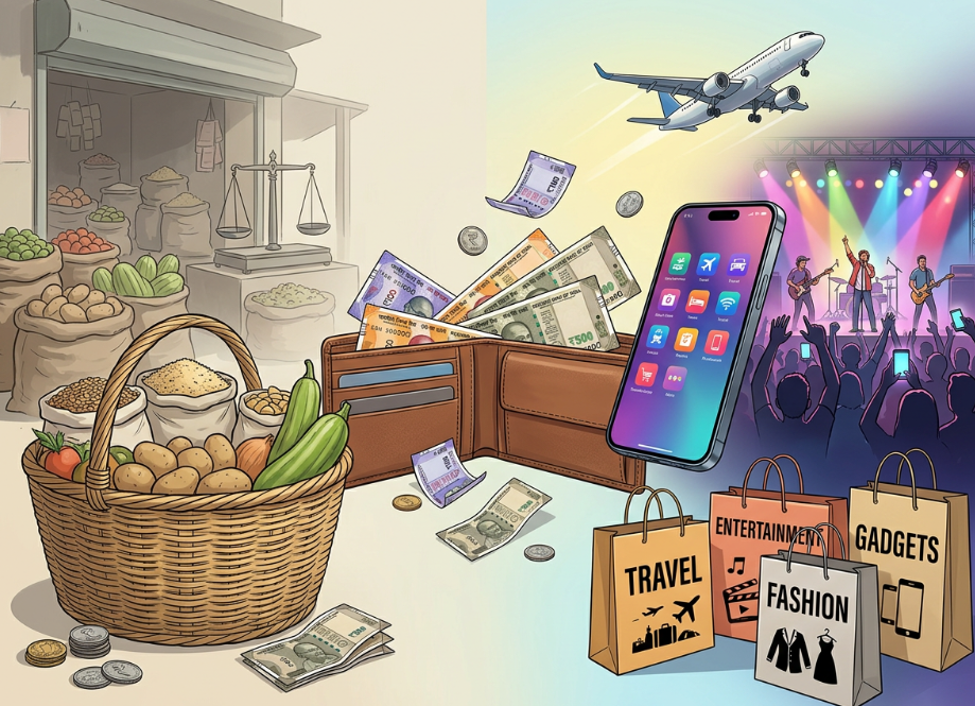
Indian consumption is shifting from essentials to experiences and premium categories.
Overseas travel became the top outward expense in FY26 (Rs 1.45 lakh crore).
Live events surged nationwide, including Tier-2 cities.
Premium smartphones and digital services are gaining share.
Food’s budget share is declining.
Income growth is uneven, while savings rates have fallen and debt burdens increased.
India’s consumption narrative is undergoing a visible transformation. No longer defined solely by supermarket volumes or staple-heavy household baskets, the country’s spending patterns are shifting toward experiences, premium products and discretionary categories. A recent study by Kotak Mutual Fund highlights how evolving consumer preferences are reshaping the way Indian households allocate their money.
The findings suggest that tracking consumption growth now requires looking beyond basic volume metrics. Ticketed live entertainment is expanding rapidly, high-end smartphones are capturing a larger slice of sales, and overseas travel expenditure has surged. Together, these trends reveal a consumer wallet that is gradually pivoting from essentials toward lifestyle-driven choices.
Overseas travel emerges as a major spending avenue
One of the most striking developments is the scale of outbound spending. According to the report, foreign travel became the largest outward spending category in FY26 up to February, touching roughly Rs 1,45,000 crore. In parallel, overseas investments in equity and debt instruments multiplied 7.3 times over the past three years.
The study frames this outward flow not as a niche indulgence but as a structural shift in priorities. Foreign holidays, once limited to a small segment of households, are increasingly becoming mainstream among higher-income groups. The strong momentum in overseas travel since FY22–23 underscores the depth of this transition, positioning it as a defining feature of the current consumption cycle.
The rise of the concert economy
Paid experiences have become another powerful indicator of changing preferences. India’s live entertainment landscape has expanded dramatically, with ticketed events rising from 19,000 in 2022 to 34,000 in 2025.
Growth is not confined to metropolitan centres. Tier-two cities posted a remarkable 682% increase in live events in 2024, signalling that organised entertainment spending is spreading into emerging consumption hubs.
Demand levels reflect this enthusiasm. One major international concert reportedly attracted interest from 1.3 crore fans despite having only 1.5 lakh tickets available. In another instance, three shows in Ahmedabad generated Rs 322 crore in ticket sales. Overall, the live events industry reached Rs 20,861 crore and continued to grow at a healthy 15% year-on-year pace.
The report groups concerts alongside OTT subscriptions, quick commerce platforms, smartphones and hearables as categories absorbing a rising share of household expenditure. The common thread is clear: consumers are spending more on convenience and experiences, often alongside premium technology.
Food’s shrinking share of the household budget
While discretionary categories expand, food is gradually occupying a smaller proportion of household spending. Data cited in the study shows that food accounted for 46% of rural expenditure in 2022–23, down from 59% in 1999–00. In urban areas, the share declined to 39% from 48% over the same period.
Within food, cereals have seen a particularly sharp fall. Rural cereal spending dropped to 5% from 22%, while urban cereal expenditure decreased to 4% from 12%.
Meanwhile, spending on beverages, processed foods, consumer durables such as mobile phones, transportation, rent and education has increased. The reallocation indicates that households are moving beyond subsistence spending and redirecting resources to services, lifestyle upgrades and long-term investments in quality of life.
Premiumisation within categories
India’s smartphone market offers a clear example of how spending behaviour is evolving. Devices priced above Rs 30,000 accounted for 26% of total units sold in calendar year 2025, up from 20% in 2020. Over this period, premium models posted a compound annual growth rate of 5.9%, while mass-market volumes declined by 1.2%.
The implication is not necessarily that more phones are being sold, but that buyers are opting for higher-value models. The same pattern is visible in related segments. Hearables recorded a CAGR of 52%, paid OTT subscriptions expanded at 40%, and Apple India’s revenue grew by 47%.
The report suggests that the composition of spending within categories now matters more than overall unit growth. Consumers appear willing to pay more for upgraded features and brand positioning, even if total sales volumes remain stable.
Uneven gains and rising financial pressure
However, the benefits of this consumption shift are not evenly distributed. Urban affluent income pools expanded at an estimated 18% CAGR between FY20 and FY25, compared with roughly 6% for urban mass segments. Rural wealthy households saw income growth of around 10.1%, versus 7.2% for rural non-agricultural labour groups.
Top-tier urban households are spending multiples of the national average on durables, jewellery, education and dining out, reinforcing a divergence in consumption capacity. The study characterises this as a deepening of income growth rather than a broad-based widening.
At the same time, financial pressures are building. Loan repayment obligations have grown faster than incomes in five of the seven years covered in the analysis. Household net financial savings stood at 5.3% of GDP in the first nine months of FY26, significantly lower than the 11.2% recorded during the corresponding period of FY21.
A rebalanced wallet
Taken together, the data points to an Indian consumer landscape that is more experience-oriented, more premium-focused and increasingly outward-looking. Yet it also highlights widening income disparities and tightening savings buffers.
India’s consumption story, once anchored in staples and mass affordability, now appears to be shaped by concerts, curated travel, high-end devices and digital subscriptions. The number of items in the shopping basket may not have dramatically changed—but the value, destination and intention behind each rupee certainly have.


Comments