


China Opens Pinglu Canal, Creating a Faster Trade Link From Inland Provinces to Southeast Asia
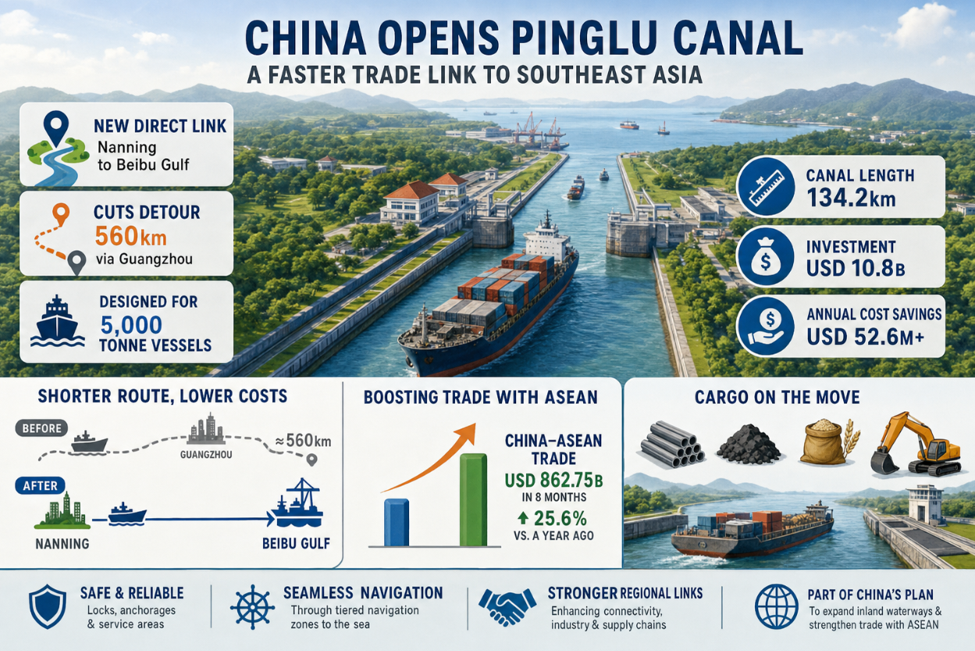
China opened the 134.2km Pinglu Canal, linking Nanning to the Beibu Gulf.
The canal cuts a roughly 560km detour via Guangzhou for inland cargo.
The project cost about USD 10.8 billion and supports 5,000-tonne vessels.
It could save over USD 52.6 million in transport costs annually.
China-Asean trade reached USD 862.75 billion in eight months, up 25.6%.
China has officially opened the Pinglu Canal to navigation, marking a major step in its effort to give the country’s southwestern inland regions a shorter and more direct route to the sea.
The 134.2km waterway, equivalent to about 83.4 miles, connects Nanning, the capital of Guangxi, with the Gulf of Tonkin, known in China as the Beibu Gulf. Its launch creates a new maritime corridor for cargo from inland provinces seeking access to Southeast Asian markets.
Before the canal, goods from the region often had to travel a much longer route through Guangzhou before reaching the sea. The new waterway removes a detour of roughly 560km, helping reduce travel time and logistics expenses for companies using the route.
With the canal’s opening on Wednesday, two freight services began operation. One is an international route linking Nanning with Can Tho in Vietnam. The other is a domestic route connecting Nanning with Yangpu in Hainan province, according to state broadcaster CCTV.
Around 30 cargo vessels were scheduled to pass through the canal on its first day of operations. The ships were carrying products including building materials, coal, minerals, steel and grain. Nanning Port and Qinzhou Port are handling operations along the route.
The first of four planned passenger services on the canal has also started, according to official media coverage of the opening.
Zhou Mi, a researcher at the Chinese Academy of International Trade and Economic Cooperation, described the Pinglu Canal as an important piece of innovative infrastructure. The think tank operates under China’s Ministry of Commerce.
Zhou said the canal not only provides a more efficient route to the sea but also helps connect provinces, encourage economic cooperation and improve the country’s broader transport network.
He also noted that the project could support the development of cleaner and more efficient transport methods. In his view, the waterway may create better conditions for regional economic coordination with neighbouring countries while helping upgrade industrial and supply chains through smarter technologies.
The Pinglu Canal involved planned investment of 72.7 billion yuan, or USD 10.8 billion. Construction began in August 2022, and the canal has been designed to accommodate vessels of up to 5,000 tonnes.
Chinese authorities expect the waterway to save more than 5 billion yuan in overall transport costs each year. That is equivalent to about USD 52.6 million.
State-run Xinhua News Agency said the project is the first man-made waterway connecting a river to the sea built in China since the founding of the People’s Republic in 1949.
The canal uses a tiered navigation-zone system intended to make movement easier for inland vessels. Under this arrangement, eligible ships can move through the canal and enter the sea without transferring their cargo to another vessel.
The opening follows several rounds of navigation trials. In mid-August, four merchant ships ranging from 1,000 tonnes to 5,000 tonnes carried out phased tests along the canal’s main channel. These trials assessed the safety and reliability of the channel, locks, anchorages and service areas.
Earlier in August, a maritime patrol vessel completed the first full-route transit test on the waterway, according to the canal’s operator. Later that month, the canal’s first command and management vessel was delivered to oversee navigation and support emergency response work.
The canal is intended to give China’s less-developed inland regions faster access to international shipping routes. It is also expected to support local industries and deepen commercial links with the Association of Southeast Asian Nations, or Asean, which is China’s largest trading partner as a bloc.
Signs of the canal’s role in trade are already appearing. Last Thursday, a multimodal freight train carrying more than 370 tonnes of construction machinery and other products arrived in Guangxi from Hunan province. The cargo was scheduled for export after the canal opened.
The Pinglu Canal also forms part of a wider national push to expand inland waterway transport. Several provinces, including Jiangxi, Hubei, Hunan and Henan, are planning or advancing major waterway projects aimed at supporting local economic growth.
According to an August 13 report by Yunnan authorities, provinces and regions such as Yunnan, Guizhou, Hunan, Sichuan and Chongqing could see logistics costs fall by about 18% to 30% by using the canal. The report described the route as the shortest, most economical and most convenient access to the sea for western China.
The canal’s construction has also encouraged investment in related infrastructure. At the
Liujing operations area of Nanning Port, berths have been upgraded so they can handle vessels of up to 5,000 tonnes.
Beibu Gulf Port is also working to draw more cargo from Chongqing, Sichuan and Yunnan. Cross-border rail lines, including the China-Laos Railway, are expected to feed cargo into the wider transport network, according to state media reports.
The opening comes at a time when China’s trade with Asean is expanding rapidly. Beijing has been working to strengthen supply chains and commercial ties with Southeast Asia as trade and technology tensions with Western countries continue.
In the first eight months of this year, total trade between China and Asean reached USD 862.75 billion, up 25.6% from a year earlier, according to customs data.
China’s exports to Asean totalled USD 546 billion during the same period, rising 25.8%. By comparison, China’s exports to the United States increased 6.2% in dollar terms.
The launch of the canal also comes just ahead of this year’s China-Asean Expo in Nanning. The annual trade and investment fair showcases a wide range of goods, including agricultural products, food, machinery and high-tech equipment.
For China, the Pinglu Canal is more than a transport project. It is a strategic link designed to connect inland manufacturing centres with maritime trade routes, reduce logistics costs and strengthen economic ties with Southeast Asia.
As cargo begins moving through the new waterway, the canal is expected to play a growing role in reshaping trade flows from western and southwestern China toward Asean markets.


Comments