


Buddhist Delegation from Eastern China Embarks on Spiritual and Academic Journey to India

31-member delegation from Eastern China to visit key Buddhist sites in India.
Pilgrimage includes Varanasi, Bodhgaya, Rajgir and Nalanda.
Group led by Chief Abbott Shi Zhongshan of CIYUN Monastery.
Visit highlights renewed India–China cultural and academic connections.
A group of Buddhist pilgrims and students from Eastern China is set to travel to India in the coming days, marking a fresh chapter in cultural and spiritual exchanges between the two countries.
The 31-member delegation will visit several of India’s most revered Buddhist destinations, including Varanasi, Bodhgaya, Rajgir and Nalanda. The journey is being viewed as part of broader efforts to strengthen civilizational ties rooted in centuries-old spiritual traditions.
Indian Consul General in Shanghai, Pratik Mathur, formally bid farewell to the delegates before their departure. The group is led by Chief Abbott Shi Zhongshan of the historic CIYUN Monastery in Yangzhou, a city recognized today as a major artificial intelligence hub in China but one that also carries deep historical and religious significance.
During his interaction with the delegation, Mathur encouraged the participants to observe firsthand the ongoing restoration and redevelopment initiatives at Nalanda. He pointed to the transformation of the ancient university site as a symbol of shared heritage and intellectual exchange between India and China.
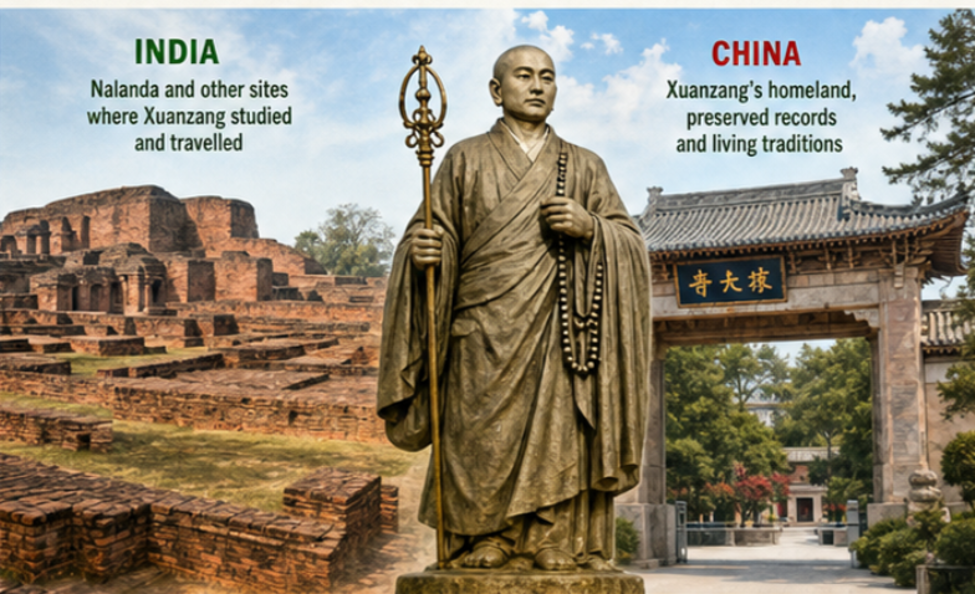
According to a statement shared by the Indian Consulate in Shanghai, landmarks such as the Xuanzang Memorial Hall at Nalanda serve as enduring reminders of the centuries-old Buddhist connections linking the two civilizations. The Memorial Hall commemorates the famed Chinese monk Xuanzang, who traveled to India in the 7th century in pursuit of Buddhist teachings and later helped transmit that knowledge back to China.
Mathur also highlighted the significance of the modern Nalanda University campus, described as a unique net-zero green institution. The university’s revival is seen as an effort to reconnect with the spirit of ancient scholarship while promoting sustainable development and international collaboration.
The upcoming visit underscores the enduring cultural bonds between India and China that transcend contemporary geopolitical complexities. Buddhist pilgrimages and academic exchanges have historically played a vital role in fostering mutual understanding, and initiatives such as this delegation are viewed as a continuation of that legacy.
As the group prepares to walk through the historic corridors of Bodhgaya and Nalanda, their journey symbolizes not only spiritual reflection but also a reaffirmation of long-standing people-to-people ties between the two neighboring nations.


Comments